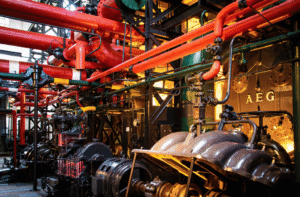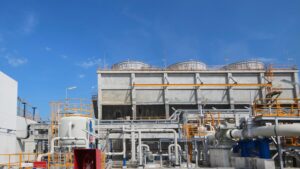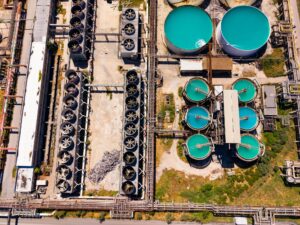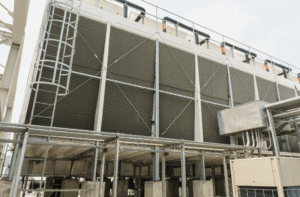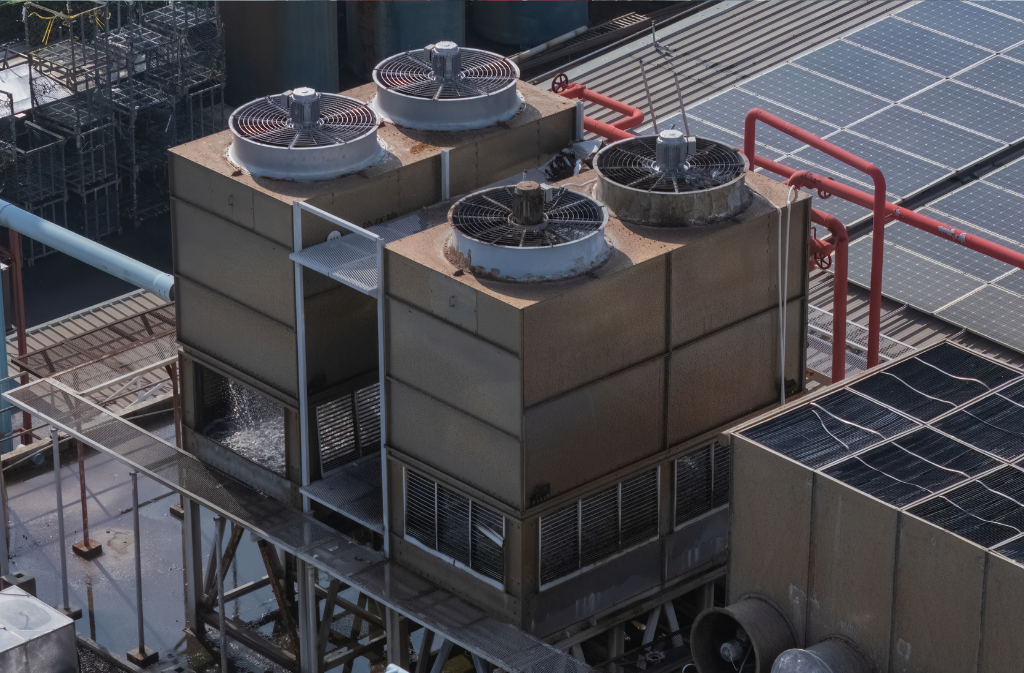
Industrial water systems can create favorable conditions for bacteria, algae, fungi, and other microorganisms to multiply. In cooling towers and other recirculating cooling systems, unchecked microbial growth may contribute to biofilm formation, restricted water flow, reduced heat transfer, process contamination, corrosion, and higher operating costs.
Non oxidizing biocides are water treatment chemicals used to control microorganisms through targeted cellular mechanisms rather than oxidation alone. Depending on the active ingredient, these products may disrupt the cell membrane, interfere with enzymes, damage cellular proteins, or interrupt metabolic reactions. When selected according to system conditions and applied as part of a complete water treatment program, they can support more reliable microbial control and help protect industrial equipment.
Key Takeaways
- Non oxidizing biocides control bacteria, algae, fungi, and other microorganisms by targeting cellular functions rather than relying primarily on oxidation.
- Common chemistries include isothiazolinones, DBNPA, glutaraldehyde, THPS, and quaternary ammonium compounds.
- Product performance depends on water chemistry, concentration, contact time, circulation, system conditions, and compatibility with other water treatment chemicals.
- Biofilm can reduce treatment penetration because extracellular polymeric substances form a protective layer around attached microorganisms.
- Effective microbial control may require a combination of biocides, cleaning, filtration, biodispersants, monitoring, and operational improvements.
- Oxidizing and non-oxidizing biocides may be used together to provide broader control and reduce reliance on a single mode of action.
- ETI supports water treatment professionals, distributors, and OEMs with biocide chemistries, private-label options, regulatory assistance, testing tools, and technical guidance.
What Are Non-Oxidizing Biocides?
Non oxidizing biocides are chemical treatments designed to control bacteria, fungi, algae, and other microorganisms without relying primarily on oxidation. Unlike oxidizing biocides, which use oxidizing agents to damage microbial cells through a redox reaction, non-oxidizing products target specific cellular functions and structures.
Their mode of action depends on the chemical structure of the active ingredient. Some products disrupt the cell membrane and affect the lipids that help maintain cell integrity. Others interfere with enzymes, thiol groups, proteins, or metabolic reactions that bacterial cells need for growth and survival. Certain chemistries may also damage cell walls, interrupt respiration, or prevent microorganisms from reproducing.
Because each active ingredient works differently, these biocides are not interchangeable. Product selection should consider the target organisms, water chemistry, operating conditions, contact time, and compatibility with other biocide for water treatment chemicals already present in the system.
Oxidizing and Non-Oxidizing Biocides Compared
Oxidizing and non-oxidizing biocides control microorganisms through different chemical mechanisms. Oxidizing biocides rely on an oxidation or electron transfer reaction that damages essential components of microbial cells, while non-oxidizing products interfere with specific cellular structures or metabolic functions. In many industrial water treatment programs, both categories are used because they provide different treatment strengths.
| Comparison Factor | Oxidizing Biocides | Non-Oxidizing Biocides |
|---|---|---|
| Mode of action | Use oxidizing power to damage cell walls, proteins, enzymes, and other cellular components | Disrupt the cell membrane, inhibit enzymes, affect thiol groups, or interfere with metabolic reactions |
| Common examples | Chlorine, bromine, chlorine dioxide, sodium hypochlorite, hydrogen peroxide, and peracetic acid | Isothiazolinones, DBNPA, glutaraldehyde, THPS, and quaternary ammonium compounds |
| Typical feed approach | May be applied continuously, semi-continuously, or intermittently | Commonly applied intermittently or through controlled slug feeding |
| Main program role | Provide routine control of bacteria, algae, and other microorganisms in circulating water | Support targeted control of persistent organisms, biofilm-associated bacteria, and difficult system conditions |
| Important considerations | pH, oxidant demand, corrosion potential, organic loading, and residual control | Contact time, concentration, compatibility, target organisms, and discharge requirements |
Some oxidizing agents have strong oxidizing power and can kill bacteria rapidly, but their performance may decline when organic material or other oxidant-demanding substances are present. Non-oxidizing products may provide broader control under selected operating conditions, although their good efficacy depends on correct concentration, sufficient contact time, and proper application.
A complete microbial-control program does not always require choosing one category over the other. Coordinated use of oxidizing and non-oxidizing chemistries can provide broad spectrum control while reducing dependence on a single treatment mechanism.
Common Types of Non-Oxidizing Biocides
Non oxidizing biocides include several main classes of active ingredients, each with a different chemical structure and mode of action. Their performance can vary according to pH, temperature, microbial population, concentration, contact time, and the other chemicals present in the system.
Isothiazolinones
Isothiazolinones provide broad spectrum control against bacteria, algae, and fungi in many industrial water applications. They act by reacting with thiol groups in cellular enzymes, which disrupts metabolic reactions and limits microbial growth. Their good efficacy depends on water chemistry because reducing agents, sulfides, high pH, and other contaminants may affect product stability and performance.
DBNPA
DBNPA is a fast-acting biocide that interferes with essential proteins and enzymes inside microbial cells. It is often selected when rapid control is needed, but it also breaks down relatively quickly, making feed timing and contact time important. Its shorter persistence can be beneficial in some systems, although the product must remain at an effective concentration long enough to reach the target microorganisms.
Glutaraldehyde
Glutaraldehyde reacts with proteins in bacterial cells through irreversible cross linking, which damages cellular structures and interferes with normal functions. It can be highly effective across a broad range of industrial applications when applied correctly. Performance may still be pH dependent and influenced by temperature, organic loading, system retention, and the required contact time, which may extend for several hours in some applications.
THPS
THPS is used in selected cooling, process water, and specialty industrial systems to control bacteria and other microorganisms. It may offer good efficacy under a range of operating conditions, but compatibility with corrosion inhibitors, process contaminants, and discharge requirements must be evaluated. Product selection should also account for treatment goals, microbial species, and the chemistry already present in the water.
Quaternary Ammonium Compounds
Quaternary ammonium compounds disrupt the cell membrane by interacting with negatively charged components of the microbial surface. This damage can cause cellular contents to leak and may also help loosen biological deposits. Quaternary ammonium products can provide effective control, but users must consider foaming potential, interactions with anionic water treatment chemicals, water hardness, and application-specific restrictions.
Why Biofilm Makes Microbial Control More Difficult
Biofilm begins when microorganisms attach to wet system surfaces and produce extracellular polymeric substances. This material forms a protective layer around bacterial cells and other organisms, helping them remain attached to piping, heat exchangers, cooling tower fill, storage vessels, and other water-contact surfaces.
The biofilm matrix can trap nutrients, fatty acids, suspended particles, and inorganic ions while limiting how effectively biocides reach deeper microbial populations. Because attached microbiological growth behaves differently from free-floating bacteria, a bulk-water sample may appear acceptable even when persistent deposits remain on equipment surfaces.
Uncontrolled biofilm can contribute to several operational problems:
- Reduced heat transfer across fouled surfaces
- Restricted water flow through piping and equipment
- Higher operating costs caused by reduced efficiency
- Process contamination in sensitive applications
- Microbiologically induced corrosion beneath deposits
- Persistent bacterial growth that returns after treatment
- Increased accumulation of airborne contaminants in open cooling towers
For this reason, chemical treatment must address both free-floating microorganisms and attached biological deposits. Established biofilm may also require cleaning, filtration, biodispersants, or other corrective measures in addition to routine biocide application.
Factors in Selecting and Applying a Biocide
Choosing an appropriate biocide requires a clear understanding of the system conditions, treatment goals, and microorganisms present. A product that performs well in one application may provide limited control in another if the water chemistry, operating conditions, concentration, or contact time are different.
Target Organisms and System Conditions
The first step is identifying whether the system is dealing with free-floating bacteria, attached biofilm, algae, fungi, or other harmful bacteria. The type of cooling system, system volume, water flow, temperature, retention time, and areas of stagnation can all affect treatment performance. Open cooling towers may also receive airborne contaminants that increase biological demand.
Water Chemistry
Water pH, organic loading, suspended solids, inorganic ions, and process contaminants can influence biocide stability and activity. Some industrial waters may also contain fatty acids, heavy metals, or traces of organic solvents that interfere with treatment or increase chemical demand. Because certain products are pH dependent, water chemistry should be reviewed before selecting a formulation.
Concentration and Contact Time
Effective microbial control depends on maintaining the correct concentration for a sufficient contact time. A high concentration does not automatically produce better results and may increase chemical use, operating costs, and discharge concerns. Feed timing should account for system turnover, blowdown, circulation, and the several hours some products may require to achieve good efficacy.
Chemical Compatibility
Biocides must be compatible with corrosion inhibitors, scale-control products, dispersants, reducing agents, and other water treatment chemicals present in the system. Quaternary ammonium products, for example, may react with anionic chemicals, while some non-oxidizing chemistries can be affected by reducing conditions. Compatibility testing helps prevent loss of performance, precipitation, foaming, or unintended corrosion.
Discharge and Regulatory Requirements
Biocide treatments must be applied correctly and in accordance with the product label, safety documentation, and applicable discharge requirements. Treatment professionals should review permitted uses, feed limits, storage requirements, PPE, and local wastewater restrictions before changing a chemical treatment program.
Before selecting a product, evaluate:
- Target microorganisms and existing biofilm
- Water pH, temperature, and contaminant loading
- System volume, circulation, and water flow
- Required concentration and contact time
- Compatibility with existing chemicals
- Feed location and application method
- Monitoring and residual-testing options
- Discharge and handling requirements
Building a Complete Microbial-Control Program
Non oxidizing biocides are most effective when they are used as part of a coordinated microbial-control program rather than as a stand-alone response to visible fouling. A complete approach combines chemical treatment with system inspection, cleaning, monitoring, and operational adjustments.
- Evaluate the system and identify whether the main concern involves free-floating bacteria, algae, fungi, or established biofilm.
- Select compatible oxidizing and non-oxidizing chemistries based on the target organisms, water chemistry, and operating conditions.
- Establish the correct feed point, concentration, and contact time so the treatment can circulate through affected areas.
- Address sediment, stagnant zones, and existing biological deposits through cleaning, filtration, biodispersants, or biopenetrants where appropriate.
- Verify performance using residual testing, ATP testing, dip slides, visual inspections, corrosion monitoring, and biofilm indicators.
- Adjust the biocide treatments as water quality, seasonal conditions, system demand, or microbial activity changes.
Oxidizing biocides may provide routine control in circulating water, while non-oxidizing products can support broader spectrum treatment against persistent or biofilm-associated microorganisms. When applied correctly, this combined strategy can help control microbiological growth, protect cooling systems, and reduce the risk of repeated bacterial growth.
Chemical treatment alone may not remove severe deposits, restore restricted water flow, or correct mechanical problems. Persistent fouling in cooling towers and other industrial systems may require physical cleaning and operational changes before a biocide program can deliver consistent results.
ETI Biocide Products and Technical Support
Eastern Technologies, Inc. supports independent water treatment companies, distributors, and OEMs with a broad portfolio of microbial-control products and the technical resources needed to apply them effectively. Rather than competing for the end-user relationship, ETI serves as a chemical manufacturer and technical partner that helps water treatment professionals build stronger treatment programs for their own customers.
Relevant capabilities include:
- More than 35 oxidizing and non-oxidizing biocide chemistries
- Isothiazolin, DBNPA, glutaraldehyde, THPS, quaternary ammonium products, and specialty blends
- Bromine-based and chlorine-based oxidizing biocides
- Biopenetrants and surfactants that support biofilm control
- Private-label and manufacturer-label product options
- EPA and state registration assistance
- Glutaraldehyde test kits and HMB X biofilm monitoring systems
- Application guidance, laboratory support, field troubleshooting, and regulatory documentation
- Custom chemical blending for cooling, wastewater, membrane, and industrial water applications
ETI can also help evaluate system conditions, chemical compatibility, treatment objectives, and monitoring options before a program is introduced or adjusted. Its custom formulation capabilities allow partners to develop application-specific water treatment chemicals that support microbial control while integrating with corrosion inhibitors, dispersants, and other components of a complete treatment program.
Explore ETI’s biocide products, custom chemical blending, and technical support for water treatment professionals, or contact ETI today to discuss the right microbial-control solution for your customers.
Frequently Asked Questions (FAQs)
What is the difference between oxidizing and non-oxidizing biocides?
Oxidizing biocides use oxidation to damage cell walls, proteins, and enzymes, while non-oxidizing products target specific cellular functions such as the cell membrane or metabolic reactions. Both types may be used in the same water treatment program when broader microbial control is required.
How long do non-oxidizing biocides need to remain in a system?
Required contact time varies by chemistry, concentration, water flow, and system conditions, with some applications requiring several hours of exposure. Treatment professionals should follow the product label and verify that the active ingredient remains present long enough to achieve good efficacy.
Can non-oxidizing biocides remove established biofilm?
They can help control microorganisms within biofilm, but the extracellular polymeric substances forming its protective layer may reduce treatment penetration. Established deposits may also require cleaning, filtration, biodispersants, or other corrective measures alongside chemical treatment.
Why are multiple biocides used in one water treatment program?
Using oxidizing and non-oxidizing products can provide broad-spectrum control against bacteria, algae, fungi, and other microorganisms. Rotating compatible biocide treatments may also reduce dependence on one mode of action and help address changing bacterial growth conditions.
What conditions affect non-oxidizing biocide performance?
Performance may be pH-dependent and influenced by temperature, contact time, concentration, organic loading, and compatibility with corrosion inhibitors or other water treatment chemicals. Careful evaluation of operating conditions helps ensure the product is applied correctly and delivers consistent microbial control.