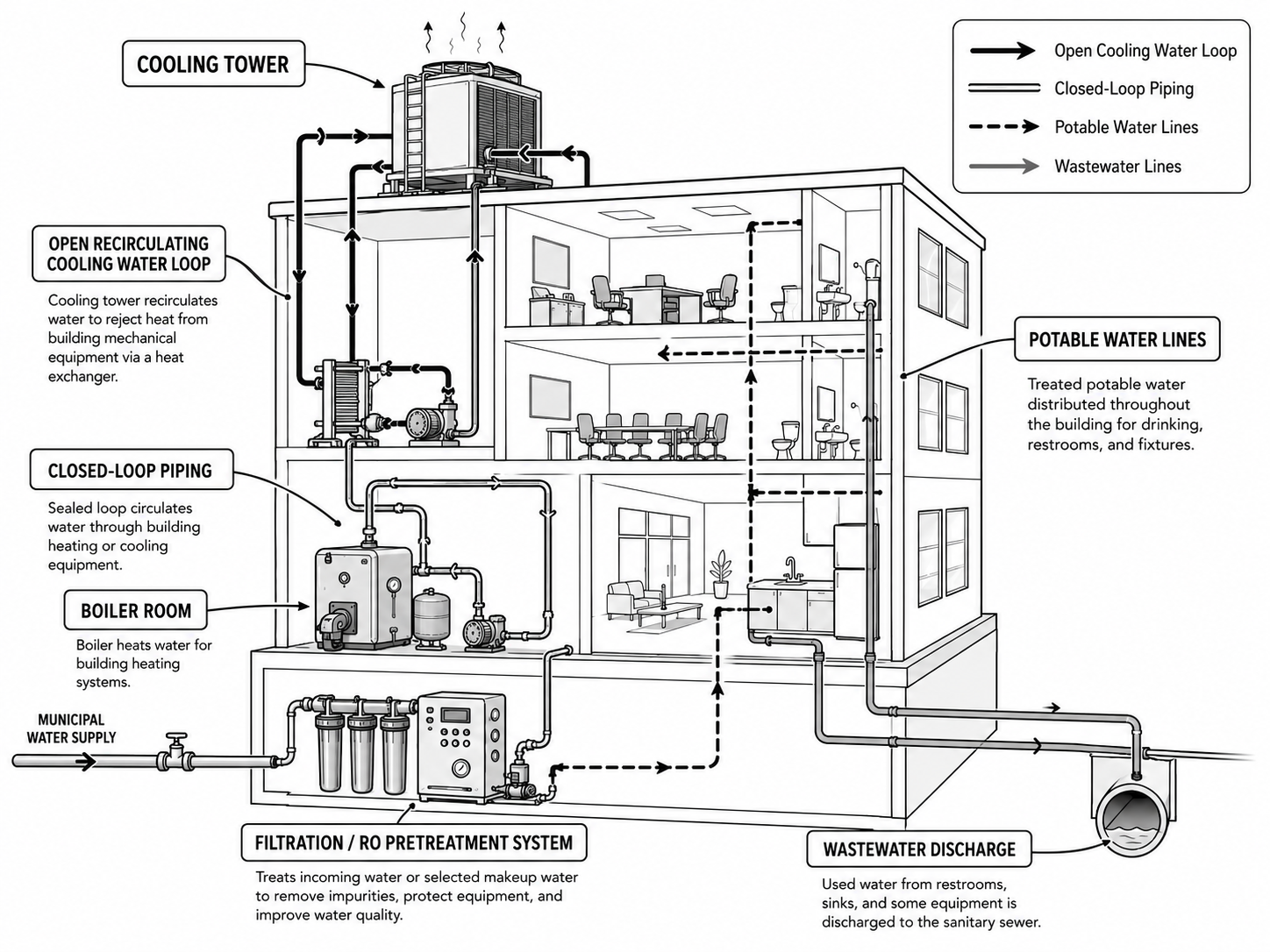
Commercial, institutional, and industrial buildings rely on several interconnected water systems, including cooling towers, boilers, closed loops, potable water lines, filtration equipment, and specialized process systems. Each operates under different temperatures, flow rates, water chemistry conditions, and equipment requirements. Without proper control, scale, corrosion, sediment, bacteria, and other contaminants can significantly affect system reliability, water quality, maintenance demands, and overall cost.
A coordinated building water treatment program helps address these risks through testing, treatment, monitoring, and documented operating procedures. When properly designed, the program can protect pipes and equipment, support energy efficiency, maintain cleaner water, and help facilities meet applicable regulatory requirements. It also gives water treatment professionals a structured way to evaluate system conditions and adjust treatment as building operations change.
Key Takeaways
- Building water treatment protects water quality and equipment.
- Each building system requires a tailored treatment approach.
- Monitoring helps detect scale, corrosion, bacteria, and fouling.
- Proper treatment can support efficiency and reduce maintenance costs.
- ETI equips water treatment professionals with products and technical support.
What Is Building Water Treatment?
Building water treatment is the coordinated management of water after it enters a commercial, institutional, or industrial facility. It includes the treatment processes used to control scale, corrosion, sediment, bacteria, and other contaminants in cooling towers, boilers, closed loops, potable water systems, filtration equipment, and process applications. The goal is to maintain suitable water quality while protecting pipes, heat-transfer surfaces, and other critical equipment.
This differs from a municipal water treatment plant, which treats source water before it enters a public distribution system. A building program focuses on the conditions that develop inside a specific facility, where temperature, stagnation, flow patterns, and system design can change the quality of treated water. It may include chemical treatment, filtration, reverse osmosis, flushing, monitoring, and maintenance as part of a broader water safety plan.
Which Building Water Systems Require Treatment?
Different building systems require different treatment methods because each operates under unique temperatures, flow rates, water chemistry, and equipment conditions. A treatment program should be selected according to the intended use of the water, the materials in the system, and the risks that need to be controlled.
| Building water system | Common concerns | Main treatment objectives |
|---|---|---|
| Cooling towers | Scale, corrosion, bacteria, biofilm, and suspended solids | Maintain heat-transfer efficiency, control deposits, and manage microbial growth |
| Boilers | Scale, dissolved oxygen, corrosion, foaming, and carryover | Protect pressure equipment, maintain suitable water chemistry, and support reliable steam generation |
| Closed loops | Corrosion, sediment, glycol degradation, and oxygen intrusion | Protect pipes, heat exchangers, and mixed-metal components |
| Potable water systems | Stagnation, sediment, bacteria, disinfectant loss, and corrosion | Support water quality, water safety, and proper distribution conditions |
| Filtration and membrane systems | Fouling, contaminants, suspended solids, and filter media loading | Improve treated water quality and protect downstream equipment |
| Building wastewater systems | Solids, oils, metals, organic matter, and liquid wastes | Prepare wastewater for discharge, reuse, or further treatment |
These systems should not be treated interchangeably. For example, chemicals designed for cooling towers may not be approved for potable water, while boiler treatment products must be selected according to operating pressure, feedwater quality, and equipment requirements. Reverse osmosis, filtration, and other treatment processes may also be added where source water conditions or system demands require additional control.
Common Problems in Building Water Systems
Water conditions can change as water moves through pipes, storage equipment, heat-transfer surfaces, and treatment components. Four common problems can significantly affect performance, maintenance requirements, water quality, and operating cost.
Scale and Mineral Deposits
Hardness minerals and other dissolved solids can precipitate as water is heated, evaporated, or concentrated. These deposits can restrict flow, reduce heat transfer, increase energy use, and create additional maintenance demands.
Corrosion
Corrosion can damage pipes, boilers, heat exchangers, storage tanks, and other equipment. It may be influenced by pH, dissolved oxygen, temperature, conductivity, microbiological activity, and incompatible metals within the system.
Microbiological Growth
Warm temperatures, sediment, nutrients, and stagnant water can support bacteria and biofilm. In some systems, uncontrolled growth may contribute to fouling, reduced treatment effectiveness, and increased risk from waterborne diseases.
Fouling and Suspended Solids
Sediment, corrosion products, organic matter, and suspended solids can accumulate on surfaces or in filtration equipment. This buildup may interfere with chemical treatment, reduce flow rates, overload filter media, and prevent systems from producing clearer water.
How a Building Water Treatment Program Is Developed
A reliable building water treatment program begins with a clear understanding of the site, its water systems, and the conditions that may affect performance. The design process should combine water testing, equipment review, treatment selection, monitoring, and documented corrective action.
- Survey the site and map the water systems
Identify incoming water sources, storage tanks, cooling towers, boilers, closed loops, filtration equipment, process systems, and discharge points. The review should also note areas with limited access, low flow, or inadequate space for testing and maintenance. - Test incoming and system water
On-site and laboratory testing may include pH, hardness, alkalinity, conductivity, metals, suspended solids, and microbiological indicators. These results help establish baseline water quality and treatment needs. - Identify risks and operating priorities
Evaluate scale, corrosion, fouling, bacteria, flow rates, equipment condition, and potential environmental impacts. This step helps determine which issues require immediate control. - Select treatment and control methods
The program may use chemicals, filtration, reverse osmosis, flushing, blowdown, temperature control, or mechanical cleaning. Each method should match the system, contaminants, and operating conditions. - Establish monitoring procedures
Standard operating procedures should define test frequencies, target ranges, responsibilities, documentation, and corrective actions. Remote monitoring may also help identify changes before they cause equipment damage or prevent delays in treatment response. - Review and improve the program
Treatment performance should be evaluated through trend data, inspections, maintenance records, chemical use, and system condition. Adjustments may be needed as water quality, occupancy, load, or equipment changes.
Monitoring, Documentation, and Regulatory Considerations
Effective water treatment depends on consistent monitoring, accurate records, and clearly defined control limits. Chemical addition alone is not enough. Water treatment professionals need to confirm that the program is working as intended and that changes in water quality or system operation are identified early.
Common monitoring parameters may include:
- pH
- Conductivity
- Temperature
- Hardness and alkalinity
- Disinfectant or inhibitor residual
- Corrosion indicators
- Microbiological activity
- Glycol concentration
- Flow and stagnation conditions
Standard operating procedures should define where samples are collected, how often testing is performed, who is responsible, and what corrective action is required when results fall outside the target range. Remote monitoring can also improve access to system data and help maintenance teams respond more quickly.
Requirements may vary according to the system, facility type, equipment specifications, product labels, and local regulations. Potable water applications must follow applicable Environmental Protection Agency guidance, the Safe Drinking Water Act, and other relevant safety standards intended to protect public health.
Supporting Water Treatment Professionals Serving Buildings
Building systems vary widely in water chemistry, operating temperature, equipment materials, flow conditions, and contamination risk. ETI supports independent water treatment companies, distributors, and OEMs with the products and technical resources needed to develop effective building water treatment programs for their customers. As a chemical manufacturer and technical partner, ETI helps professionals address system-specific challenges without competing for the end-user relationship.
Relevant capabilities include:
- Cooling and boiler water treatment products for scale, corrosion, fouling, and heat-transfer protection
- Closed-loop treatments, dispersants, alkalinity boosters, cleaners, passivators, and VpCI layup programs
- Oxidizing and non-oxidizing biocides supported by application and regulatory guidance
- Potable water treatment products for disinfection, filtration support, pH adjustment, and corrosion control
- Reverse osmosis and membrane treatment chemicals, including antiscalants and membrane cleaners
- Wastewater treatment chemicals for suspended solids removal, clarification, dewatering, and treated effluent quality
- Custom chemical blending backed by ISO 9001-certified manufacturing, laboratory validation, and quality control
- Technical support that includes water analysis, troubleshooting, field guidance, operator training, and regulatory documentation
ETI combines broad product capabilities with custom formulation, private labeling, and practical technical support. Contact ETI Water to strengthen the treatment programs, product offerings, and problem-solving capabilities your company provides to building clients.
Frequently Asked Questions (FAQs)
What systems are included in building water treatment?
Building water treatment may include cooling towers, boilers, closed loops, potable water systems, filtration equipment, reverse osmosis units, and wastewater systems. Each system requires treatment based on its water quality, operating conditions, equipment, and intended use.
How is building water treatment different from a water treatment plant?
A water treatment plant or centralized water treatment facility typically treats drinking water before it enters a distribution network. Building-level treatment focuses on maintaining water quality after water reaches a specific site, facility, or group of buildings.
Can water treatment improve building energy efficiency?
Yes, effective treatment can help limit scale, fouling, and sediment that reduce heat transfer and increase pumping or heating demands. Cleaner system surfaces may improve equipment performance, reduce maintenance, and lower overall cost.
What should be monitored in a building water treatment program?
Monitoring may include pH, conductivity, temperature, flow rates, chemical residuals, corrosion indicators, bacteria, and suspended solids. Standard operating procedures should also define testing frequency, acceptable limits, documentation, and corrective actions.
Does building water treatment support safe drinking water?
Proper potable water treatment can support safe drinking water, water safety, infrastructure protection, and public health. Programs must use approved products and follow the Safe Drinking Water Act, Environmental Protection Agency requirements, and other applicable safety standards.