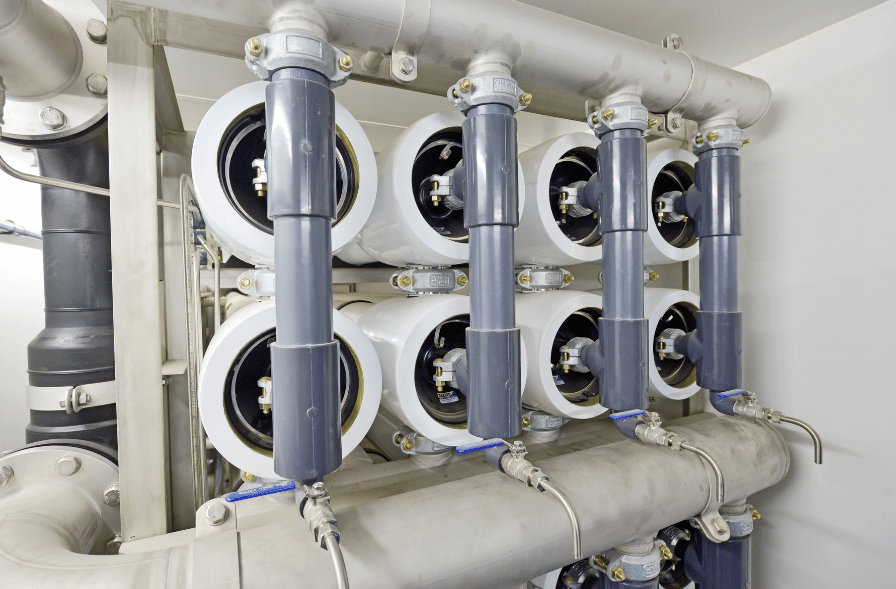
At 75% recovery, a reverse osmosis system can produce a concentrate stream containing approximately four times the feedwater’s dissolved salt concentration. This simplified mass balance assumes essentially complete salt rejection and no precipitation; it illustrates why increasing water recovery requires careful attention to scale formation.
Cooling towers face a related challenge as evaporation concentrates minerals in circulating water. For independent water treatment professionals and OEMs, antiscalant chemistry helps manage these risks when selected for the application. Effective control depends on mineral composition, operating conditions, chemical compatibility, and reliable dosing. This article explains how antiscalants work, how RO and cooling requirements differ, and how professionals evaluate selection and performance without assuming that one formulation suits every system.
Key Takeaways
- Select antiscalants using representative water analysis, projected concentration conditions, and product-specific performance limits.
- Evaluate RO and cooling applications separately. Confirm compatibility with membranes, equipment materials, and other treatment chemicals before selecting or substituting products.
- Verify chemical delivery and monitor system performance. ETI’s products, laboratory services, and technical guidance help partners investigate concerns and make informed treatment decisions.
How Antiscalants Control Mineral Deposits
Antiscalant chemistry helps manage the precipitation and deposition of sparingly soluble salts. Depending on the formulation and application, an antiscalant chemical can interfere with crystal growth and help limit particle accumulation. These effects are commonly described through three related mechanisms.
Threshold Inhibition
Threshold inhibition allows relatively small quantities of inhibitor to delay precipitation or slow crystal growth under suitable conditions. Inhibitor molecules interact with developing crystals, disrupting growth without needing to bind every dissolved scale-forming ion.
For calcium salts and other minerals, effectiveness depends on the degree of supersaturation, temperature, pH, and the selected chemistry. Inhibition has operating limits, so increasing concentration or recovery can eventually exceed a product’s demonstrated capabilities.
Crystal Modification
Some inhibitors alter how crystals form and grow. By interacting with crystal surfaces, they can produce shapes or structures that are less likely to develop into adherent deposits.
This mechanism overlaps with growth inhibition and varies with the mineral and formulation. It should not be interpreted as a guarantee that crystals cannot form.
Dispersion
Dispersant components help keep small particles separated and reduce their tendency to agglomerate or deposit. This can complement inhibition, particularly where suspended material contributes to fouling.
These mechanisms support scale prevention, but they do not remove hardness from the water or replace appropriate cleaning of existing deposits. Product selection must therefore account for both dissolved mineral risks and other sources of fouling.
Compare RO and Cooling System Requirements
RO and open recirculating cooling systems both concentrate dissolved minerals, but they do so through different processes. An RO antiscalant must suit membrane operation, while cooling treatment chemicals must function within a program that also manages heat transfer, corrosion, and microbial activity.
| Consideration | Reverse Osmosis | Open Recirculating Cooling |
|---|---|---|
| Concentration mechanism | Water passes through the membrane, leaving rejected salts in the concentrate. | Evaporation removes water while dissolved minerals remain in circulation. |
| Operating variables | Recovery, membrane flux, feedwater composition, temperature, and flow influence scaling conditions. | Cycles of concentration, makeup water chemistry, pH, and heat load influence scaling conditions. |
| Protection objective | Limit mineral deposition that impairs membrane productivity and separation performance. | Limit deposits that restrict flow and impair heat transfer. |
| Compatibility checks | Evaluate membrane requirements and interactions with upstream treatment chemicals. | Evaluate interactions with corrosion inhibitors, biocides, system materials, and other program components. |
| Performance monitoring | Track normalized permeate flow, salt passage, and differential pressure. | Track water chemistry, cycles, heat-transfer performance, and evidence of deposits. |
In RO, conditions at the membrane surface can differ from bulk-water measurements because rejected constituents accumulate near that surface. Selection should therefore consider system design and projected concentrate chemistry, rather than feedwater hardness alone.
In cooling systems, increasing cycles reduces blowdown but also raises dissolved mineral concentrations. The feasible operating range depends on the complete treatment program and equipment conditions.
These differences make application-specific compatibility essential. A product effective in cooling service should not be introduced into an RO system without confirmation of suitability. Incorrect selection can contribute to fouling, impaired performance, or equipment damage. Closed cooling loops also require separate evaluation because they do not follow the same evaporation-and-blowdown pattern.
Understand the Main Chemistry Families
Antiscalant chemistry includes several types of inhibitors, with performance shaped by molecular structure and formulation. Understanding these families helps professionals ask better selection questions, but a chemical category alone does not establish suitability for a particular system.
Phosphonates
Phosphonates are used in scale-control formulations because they can interfere with mineral crystal growth at relatively low concentrations. Their effectiveness depends on the specific molecule, targeted scale, and operating conditions.
Selection must consider calcium tolerance and interactions with other constituents. Under unfavorable conditions, calcium-phosphonate precipitation can itself contribute to deposits. Where phosphorus discharge restrictions apply, evaluate the formulation’s contribution within the overall treatment and discharge program.
Polyacrylates and Modified Polymers
Polyacrylates and related copolymers can provide scale inhibition and dispersion. Molecular weight and functional groups influence how a polymer interacts with minerals, suspended particles, and dissolved metals.
Modified polymers may be selected to address particular challenges, such as calcium phosphate deposition or tolerance to iron. Laboratory studies show that different polymer structures can perform differently under the same test conditions. Those results support application-specific evaluation rather than assuming every polymer performs equally across a broad operating range.
Blended Formulations
Blends combine components intended to address complementary treatment needs. In cooling applications, a formulation may incorporate antiscalants, dispersants, and corrosion inhibitors; membrane products require their own compatibility and performance evaluation.
Assess the finished product using its technical documentation and relevant operating data. A blend’s ingredient families do not establish its dosage, membrane suitability, or ability to control every mineral. Confirm the selected formulation against the actual water analysis and system requirements.
Select Chemistry Using Water Analysis and System Conditions
Selecting water treatment chemicals requires more than matching a product to a hardness reading. Build a representative water analysis, assess conditions where minerals concentrate, and confirm that the proposed formulation fits the complete treatment program.
- Review the relevant water constituents. Evaluate calcium, alkalinity, sulfate, silica, and other constituents indicated by the source and application. Barium can create sulfate-scaling concerns even when its concentration is relatively low. Iron may contribute to fouling or interfere with treatment performance. Distinguish dissolved constituents from suspended material, and investigate seasonal variation or upstream process changes that affect the analysis.
- Evaluate concentration and operating conditions. For RO, assess projected concentrate chemistry at the proposed recovery, accounting for membrane design and temperature. For cooling systems, examine cycled water conditions, pH, and temperatures relevant to deposition. Calcium carbonate indices provide useful information about that mineral, but they do not establish control of sulfate salts, silica, or every other deposit. Treat projections as decision tools that require operating verification.
- Check interactions across the treatment train. Review membrane compatibility and potential carryover of coagulants, metals, or other chemicals. Cationic polymers can interact adversely with anionic antiscalants, so upstream treatment deserves attention. In cooling applications, consider compatibility with corrosion inhibitors and microbial control products. Silica control requires particular care because suitable chemistry and operating limits vary depending on water composition and conditions.
- Confirm product-specific documentation. Ask the manufacturer for application guidance, recommended dosing conditions, compatibility information, and supporting performance details. Where drinking-water chemical certification is relevant, verify the specific listing and use restrictions. Such certification addresses health effects within its scope; it does not establish universal scale-control performance.
Resolve gaps in the analysis before setting operating targets. Document the selection basis so changes in source water, recovery, or cycles can trigger a meaningful review of product suitability.
Control Dosing and Verify Performance
A suitable antiscalant can underperform if chemical delivery is inconsistent or operating conditions exceed the selection basis. Confirm both the amount being fed and the system’s response before concluding that a formulation needs replacement.
Verify Chemical Delivery
Set the dosing pump according to the product-specific recommendation and the relevant water flow. Distinguish between dosage expressed as supplied product and dosage expressed as active ingredient, since confusing the two can produce substantial feed errors.
For liquid products, account for product density and any approved dilution when calculating pump delivery. Verify actual output against the intended feed rate, then inspect suction lines, injection points, and flow signals for faults. Follow manufacturer instructions for dilution water, storage, and safe handling.
Check whether feed arrangements respond appropriately to changing flow or shutdowns. In cooling systems, confirm that the selected control method maintains the intended treatment level as makeup and blowdown change.
Interpret Operating Trends
For RO, review normalized permeate flow and salt passage alongside differential pressure. Normalization helps separate changes caused by operating conditions from deterioration in membrane performance. A decline does not identify scale by itself; biological fouling, suspended material, and other problems can produce overlapping symptoms.
For cooling systems, compare chemistry results with cycles, inspections, and heat-transfer performance under similar loads. Investigate deposits where practical and verify that sensors and test methods remain dependable.
Document adjustments and their outcomes. Increasing dosage without investigating the cause may add cost or create compatibility problems while leaving the underlying issue unresolved.
How ETI Supports Antiscalant Selection and Application
Eastern Technologies, Inc. supports independent water treatment professionals, distributors, and OEMs with products and technical guidance for evaluating antiscalant chemistry. Established in 1986 and recognized as AWT’s 2023 Supplier of the Year, ETI works through distributor partners without selling directly to end users. Its role is to equip the companies responsible for selecting and managing their customers’ treatment programs.
ETI’s membrane treatment products include antiscalants and cleaners, supported by application guidance, water chemistry studies, and private-label documentation. Its cooling and boiler treatments include formulations combining antiscalants, dispersants, and corrosion inhibitors, with custom formulation capabilities for specific requirements. Product suitability should be confirmed against the application rather than assumed from the treatment category.
Through water treatment laboratory services and technical support, partners can supplement field observations with water and deposit analysis, troubleshooting, and training. ETI also offers packaging options and product documents that help partners coordinate supply with application needs. When comparing suppliers, consider access to this support alongside product specifications, packaging type, and delivery requirements. These resources help professionals investigate performance concerns and make informed adjustments while maintaining ownership of their customer relationships.
Bring your water analysis, operating conditions, and treatment objectives to ETI Water. Discuss the chemistry and technical support your team needs to select an appropriate program and evaluate its performance.
Frequently Asked Questions (FAQs)
Can the same antiscalant chemistry be used in RO and cooling systems?
Some chemistry families serve both applications, but finished products are not automatically interchangeable because membrane compatibility, operating conditions, and other treatment components differ. Confirm suitability with the product supplier and membrane manufacturer where applicable, using the actual water analysis and proposed operating conditions.
Does “industrial grade” establish product purity or suitability?
“Industrial grade” alone does not establish a product’s purity, composition, membrane compatibility, or scale-control capabilities. Review technical specifications, application guidance, and relevant certification listings rather than assuming that a general grade description confirms suitability for the intended system or operating range.
How should professionals confirm shelf life and storage conditions?
Obtain the manufacturer’s shelf life and storage instructions for the specific product, including temperature limits and any restrictions on dilution or container materials. Follow those instructions and check with the supplier if storage conditions fall outside recommendations or the product’s appearance changes.
What information should accompany an antiscalant product name?
Request a technical data sheet, SDS, application guidance, and relevant compatibility or certification information that clearly identifies the product being supplied. These documents should support evaluation of the formulation’s intended uses and limitations, with unresolved questions addressed before selection or substitution.
How should professionals compare antiscalant price and treatment cost?
Compare purchase price or a quoted price range alongside product concentration, recommended dosage, packaging, freight, and the operating conditions behind performance claims. Evaluate total treatment cost using verified results, including cleaning frequency, downtime, and equipment performance, rather than assuming the lowest container price delivers the lowest cost.