Mineral scale can develop when dissolved salts become concentrated beyond their solubility limits and begin to precipitate from water. In industrial water systems, scale formation can affect cooling towers, heat exchangers, reverse osmosis systems, piping, and other equipment surfaces. These deposits can restrict water flow, reduce heat transfer efficiency, increase pressure drop, and contribute to higher energy consumption and maintenance requirements.
Threshold inhibition is an important scale control mechanism used to interfere with mineral precipitation before hard deposits become established. Certain scale inhibitors can work at relatively low concentrations by disrupting crystal nucleation or crystal growth, even when scale-forming minerals remain present in the water. When properly matched to water chemistry and operating conditions, this approach can help prevent scale formation, maintain system efficiency, and protect equipment from the effects of mineral scale buildup.
Key Takeaways
- Threshold inhibition helps delay mineral precipitation by interfering with crystal nucleation and growth, even at relatively low inhibitor concentrations.
- Scale inhibitor performance depends on water chemistry, scale-forming minerals, temperature, flow, and other operating conditions.
- Threshold treatment is commonly used in cooling towers, reverse osmosis systems, heat exchangers, and other industrial water applications where scale can reduce efficiency.
- ETI supports water treatment professionals with scale-control chemistry, custom formulations, laboratory analysis, and technical guidance for application-specific treatment programs.
What Is Threshold Inhibition?
Threshold inhibition is a scale inhibition mechanism in which a relatively small amount of treatment chemical interferes with the precipitation of sparingly soluble salts. The inhibitor concentration is typically much lower than the concentration of the dissolved mineral ions it is helping to control, which distinguishes this approach from stoichiometric treatments that bind ions in direct proportion to their concentration.
In an aqueous solution, scale-forming ions such as calcium and carbonate may remain dissolved until conditions favor nucleation and crystal growth. Threshold inhibitors act before or during these early stages, helping delay mineral scale formation even when the water remains supersaturated.
This behavior makes threshold treatment useful in systems where complete removal of dissolved minerals is neither practical nor necessary. Rather than eliminating hardness ions from the water, the chemical additives disrupt the scaling process so that stable scale crystals are less likely to form and adhere to equipment surfaces. As a result, threshold treatment can help prevent scale formation while allowing industrial water systems to operate under controlled mineral concentrations.
How Threshold Inhibition Works
Threshold inhibitors interfere with the early stages of mineral precipitation rather than removing dissolved ions from the water. Their effectiveness depends on how they interact with crystal nuclei, active growth sites, and the timing of crystal formation.
Interfering With Crystal Nucleation
Before visible scale develops, dissolved ions must first organize into stable crystal nuclei. In systems prone to calcium carbonate precipitation or other mineral scale formation, these nuclei provide the starting point for the scaling process.
Threshold inhibitors can disrupt the formation or stabilization of these early nuclei. By interfering with forming nuclei, they delay the point at which dissolved minerals begin developing into larger scale crystals.
Blocking Active Crystal Growth Sites
Once nuclei are present, crystals grow as additional dissolved ions attach to the crystal surface. Certain inhibitor molecules adsorb onto active crystal growth sites and interfere with this process, limiting further crystal growth.
Instead of allowing growing crystals to develop into dense, adherent deposits, the inhibitor can slow their enlargement and reduce the likelihood that they will attach strongly to equipment surfaces. This interaction is one reason scale inhibitors can remain effective even when applied at low concentrations.
Extending the Induction Period
The induction period is the time between reaching supersaturated conditions and the appearance of measurable precipitation. Threshold inhibition can extend this period, giving dissolved minerals more time to remain in solution before stable crystals form.
By delaying nucleation and limiting the growth of tiny crystals, the treatment helps reduce the rate at which mineral deposits develop. This does not mean the water is no longer supersaturated, but it can significantly slow the progression from dissolved ions to established scale buildup.
Threshold Inhibition vs. Other Scale Inhibition Mechanisms
Threshold inhibition is only one way scale control chemicals can reduce mineral deposition. Other mechanisms, including crystal modification, dispersion, and sequestration, act at different stages of the scaling process and may be combined within the same treatment program.
| Mechanism | Primary Action | Typical Effect |
|---|---|---|
| Threshold inhibition | Interferes with nucleation and early crystal growth at low concentrations | Delays or reduces mineral precipitation |
| Crystal modification | Alters the structure and crystal morphology of growing scale | Produces less adherent or more easily dispersed crystals |
| Dispersion | Keeps small crystals and suspended particles separated | Reduces accumulation on equipment surfaces |
| Sequestration | Binds selected dissolved ions in solution | Limits their availability for precipitation |
Crystal modification is closely related to threshold treatment but is not identical. Instead of primarily delaying nucleation, inhibitors may adsorb onto the crystal surface and change the way growing crystals develop. This can create irregular or weaker scale crystals that are less likely to form dense deposits.
Dispersion works after particles or tiny crystals are already present by helping keep them suspended in the water. Sequestration acts differently again by chemically binding dissolved ions. Many modern multifunctional inhibitors combine several scale inhibition mechanisms, allowing one formulation to address nucleation, crystal growth, and deposition at the same time.
Where Threshold Inhibition Is Used
Threshold inhibitors are used across a range of industrial water applications where dissolved minerals can concentrate, precipitate, and form deposits. The most effective treatment depends on the specific scale-forming salts present, the degree of supersaturation, and the operating conditions of the system.
Cooling Towers and Heat Exchangers
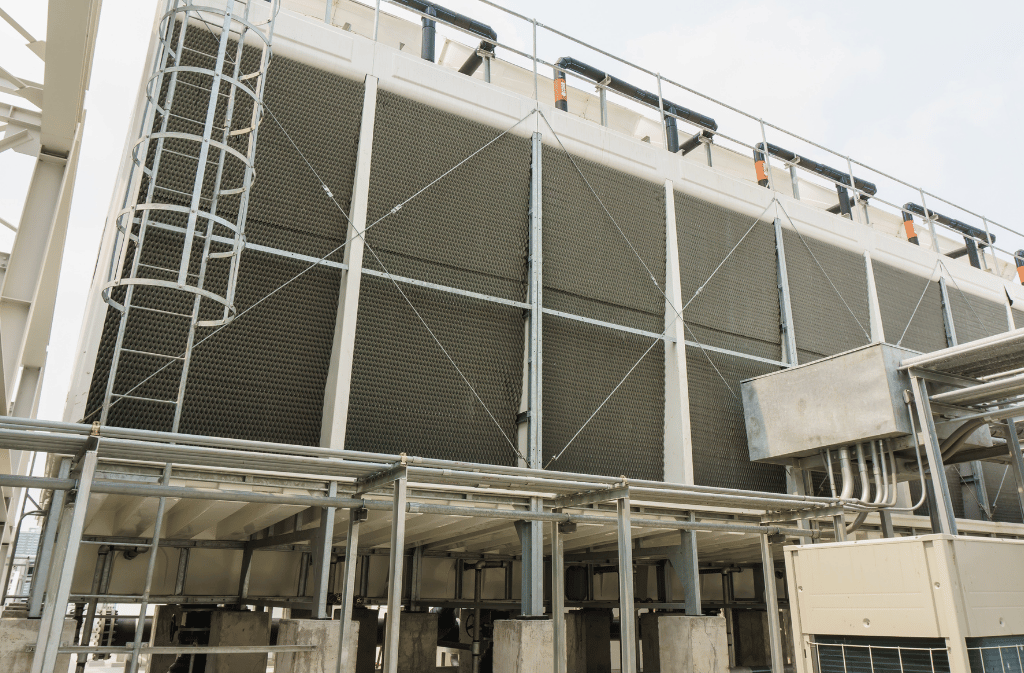
Cooling towers are especially vulnerable to mineral scale because evaporation removes water while leaving dissolved minerals behind. As cycles of concentration increase, calcium carbonate and other carbonate scales can form on heat exchangers, piping, and other heat transfer surfaces.
Threshold inhibitors help control this process by interfering with crystal growth before deposits become firmly established. Preventing scale buildup on equipment surfaces can support heat transfer efficiency, maintain water flow, reduce pressure drop, and limit the increase in energy consumption associated with fouled surfaces.
Reverse Osmosis Systems
Reverse osmosis systems also face significant scaling risk because dissolved salts become concentrated in the reject stream and near membrane surfaces. Depending on feedwater chemistry, potential deposits may include calcium sulfate, barium sulfate, strontium sulfate, carbonate scales, and other sulfate scales.
Scale inhibitors used in reverse osmosis applications are selected according to the expected mineral scale and operating conditions. Effective control helps reduce scale deposits on membranes, maintain permeate production, and support more stable system performance.
Other Industrial Water Applications
Threshold inhibition may also be applied in process water systems, high-temperature industrial water applications, and power plants where mineral concentration can contribute to reduced fluid flow or declining equipment performance. In each case, the treatment program should reflect the actual water chemistry, temperature, flow conditions, and scale risk rather than relying on a single inhibitor for every application.
Factors That Affect Scale Inhibitor Performance
The effectiveness of a scale inhibitor depends on more than the chemical itself. Water chemistry, system design, and operating conditions all influence how quickly scale forms and whether an inhibitor can provide reliable control over time.
Important factors include:
- Type and concentration of scale-forming minerals
- Calcium ions, alkalinity, and overall dissolved solids
- pH and degree of supersaturation
- Saturation index for relevant mineral species
- Water temperature and high-temperature exposure
- Thermal stability of the inhibitor
- Water flow and residence time
- Existing scale conditions or deposits
- Inhibitor dosage and feed consistency
- Interactions with other treatment chemicals
- System metallurgy and equipment design
- Overall treatment program objectives
For example, an inhibitor that performs well against calcium carbonate may not provide the same level of protection against calcium sulfate, barium sulfate, or other sparingly soluble salts. Different mineral species have different precipitation behavior, so inhibitor selection must reflect the actual scaling tendency of the water.
Threshold inhibition is therefore most effective when it is supported by accurate water analysis and regular monitoring. Matching the inhibitor to the mineral species, temperature, concentration, and operating conditions helps maintain reliable scale control and reduces the likelihood of unexpected scale buildup.
ETI Support for Scale Control Programs
At Eastern Technologies, Inc. (ETI), we support water treatment companies, distributors, and OEMs with the chemistry and technical resources needed to manage mineral scale across a range of industrial water systems. Rather than competing with our customers for end-user business, we work as a manufacturing and technical partner, helping them select and develop treatment programs suited to specific water chemistry and operating conditions.
Our scale-related capabilities include:
- Cooling and boiler treatments with antiscalants, polymer-based dispersants, and other deposit-control chemistries
- Advanced dispersant technologies designed to limit particle and scale deposition on heat transfer surfaces
- Membrane treatments, including antiscalants for reverse osmosis systems
- Custom chemical blending for high-scale-potential systems and application-specific treatment requirements
- Laboratory services, including water and deposit analysis to support treatment decisions
- Technical support for application guidance, troubleshooting, and program development
Because scale inhibition depends on mineral composition, temperature, concentration, and system conditions, we help our partners evaluate more than just product selection. Our goal is to provide the chemistry, formulation flexibility, and technical backing they need to deliver dependable scale control to their own customers.
If you need help developing or refining a scale-control program, contact ETI and let our technical team support your next application.