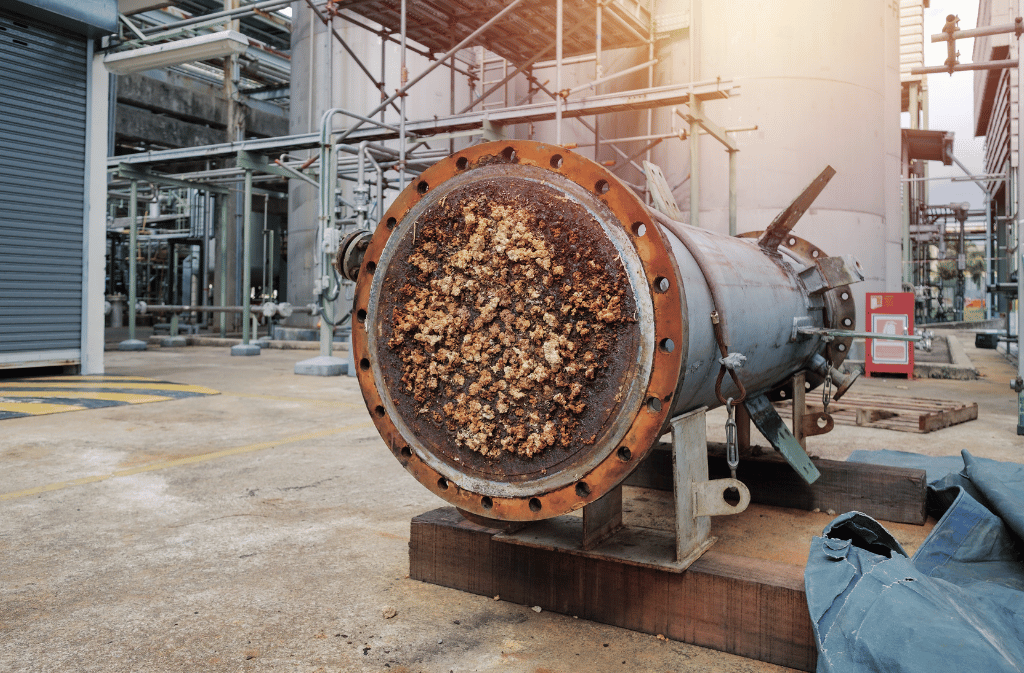
Scale formation is a persistent challenge in industrial water systems where dissolved minerals become concentrated or unstable under changing operating conditions. Minerals such as calcium carbonate and calcium sulfate can precipitate from water and form hard deposits on heat exchangers, piping, membranes, boilers, and other equipment surfaces. Over time, this scale buildup can restrict water flow, reduce heat transfer efficiency, increase energy consumption, and interfere with reliable system performance.
Scale control chemicals are used to help prevent scale formation by interfering with mineral precipitation, crystal growth, or the accumulation of suspended particles. Depending on the application, a treatment program may use phosphonates, polymers, phosphates, chelants, membrane antiscalants, or other chemical additives designed for specific water quality and operating conditions.
Understanding how these chemistries work is important because no single inhibitor is appropriate for every system or mineral deposit. Effective scale control requires evaluating the water chemistry, equipment design, temperature, concentration factors, and type of scale likely to develop before selecting the appropriate treatment approach.
Key Takeaways
- Scale control chemicals help limit mineral precipitation, crystal growth, and deposit buildup in industrial water systems.
- Phosphonates, polymers, phosphates, chelants, and membrane antiscalants each control scale through different mechanisms and applications.
- Effective treatment depends on water quality, operating conditions, system design, and the specific mineral scale that is likely to form.
- Preventive scale control helps protect heat transfer surfaces, maintain system efficiency, and extend equipment life.
- ETI supports water treatment professionals with scale and deposit control chemistry, custom formulation, laboratory services, and technical guidance.
What Causes Scale Formation in Water Treatment Systems?
Scale formation occurs when dissolved minerals in water exceed their solubility and begin to precipitate. As water chemistry changes, tiny crystal nuclei can form and develop into larger scale crystals that attach to equipment surfaces. Common mineral deposits include calcium carbonate, calcium sulfate, and other carbonate or sulfate scales that can accumulate throughout industrial water systems.
Several factors can increase the likelihood of scale deposition. In cooling towers, for example, evaporation removes water while leaving dissolved minerals behind, which increases their concentration in the circulating water. In boilers and heat exchangers, elevated temperatures can further change mineral solubility and accelerate the formation of scale on heat transfer surfaces. Reverse osmosis systems may also experience scaling as rejected minerals become increasingly concentrated near membrane surfaces.
Conditions that commonly increase scale risk include:
- High calcium hardness, alkalinity, or dissolved mineral concentrations
- Elevated temperatures or significant temperature changes
- Increasing cycles of concentration in recirculating water systems
- Changes in pH that reduce mineral solubility
- Reduced water flow or areas of localized stagnation
- High concentrations of sulfate, silica, phosphate, barium, or other scale-forming ions
- Operating conditions that concentrate minerals near equipment or membrane surfaces
Tools such as the saturation index can help water treatment professionals evaluate the tendency of certain minerals, particularly calcium carbonate, to precipitate. However, actual scale conditions depend on the complete water chemistry and system operation, so these indicators are most useful when considered alongside water quality data and equipment conditions.
How Scale Control Chemicals Work
Scale control chemicals work by interfering with the physical and chemical processes that allow dissolved minerals to form deposits. Different inhibitors act at different stages of scale formation, so industrial treatment programs often combine multiple mechanisms rather than relying on a single chemical response.
Threshold Inhibition
Threshold inhibition occurs when a small amount of treatment chemical interferes with mineral precipitation even when the water remains supersaturated. These scale inhibitors can delay the formation of crystal nuclei or disrupt early crystal growth at relatively low concentrations compared with the amount of dissolved mineral present.
This mechanism is commonly used to help prevent scale formation from calcium carbonate and other sparingly soluble salts. Effective threshold inhibition allows water systems to operate under higher mineral concentrations without immediately developing hard deposits.
Crystal Modification
Crystal modification changes the way minerals form and grow. Certain inhibitors adsorb onto the crystal surface and interfere with normal crystal growth, producing irregular or distorted scale crystals that are less likely to adhere strongly to equipment surfaces.
Instead of forming dense, tightly bonded deposits, the resulting tiny crystals may remain softer or easier to keep suspended in the water. This mechanism can be especially valuable where heat transfer surfaces are vulnerable to scale buildup.
Dispersion
Dispersants help keep small mineral particles, corrosion products, and suspended solids separated and mobile within the circulating water. Polymeric dispersants can reduce particle agglomeration and limit the ability of solids to settle onto heat exchangers, piping, and other equipment surfaces.
Dispersion does not necessarily stop every mineral from precipitating. Instead, it helps prevent those particles from combining into larger deposits that can restrict water flow, increase pressure drop, or interfere with system efficiency.
Sequestration and Chelation
Sequestering and chelating agents work by binding dissolved hardness ions or metals into soluble chemical complexes. By reducing the availability of these ions to participate in precipitation reactions, these chemical compounds can support scale control in selected industrial applications.
Unlike threshold inhibitors, chelants generally require treatment levels that more closely reflect the concentration of the ions being controlled. For that reason, the appropriate scale inhibitor depends on water quality, operating conditions, the mineral species present, and the overall treatment program.
Common Types of Scale Control Chemicals
Different scale control chemicals address mineral deposition through different mechanisms. The best option depends on water quality, the minerals present, system design, temperature, concentration cycles, and other operating conditions. In many industrial water applications, multiple chemistries are combined to provide more complete scale and deposit control.
| Chemical Type | How It Works | Common Applications | Key Considerations |
|---|---|---|---|
| Phosphonates | Provide threshold inhibition and crystal modification | Cooling towers, process water, selected membrane applications | Performance depends on calcium levels, pH, temperature, and overall water chemistry |
| Polymers and polymeric dispersants | Interfere with crystal growth and keep precipitated solids dispersed | Cooling towers, boilers, process water | Often combined with phosphonates or phosphate treatments |
| Phosphate treatments | React with hardness under controlled conditions and support deposit management | Boiler water systems | Requires proper pH, alkalinity, blowdown, and polymer support |
| Chelants | Bind hardness or metal ions into soluble complexes | Boilers and specialized industrial applications | Dosage must reflect the ions being controlled |
| Membrane antiscalants | Delay precipitation and modify crystal formation near membrane surfaces | Reverse osmosis systems | Selection should reflect the specific carbonate, sulfate, silica, or other scale risk |
| Acid and pH-control chemicals | Reduce conditions that encourage certain mineral precipitation | Selected cooling and process water systems | Requires careful control because low pH can increase corrosion risk |
Phosphonates
Phosphonates are widely used organic scale inhibitors in industrial water treatment. They can function at low concentrations by interfering with crystal nuclei and crystal growth, particularly for calcium carbonate and other sparingly soluble mineral salts.
Their effectiveness depends on the specific water chemistry. High calcium concentrations, elevated temperatures, and interactions with other treatment chemicals can influence performance, so phosphonate selection and dosage should be based on actual scale conditions rather than applied as a universal solution.
Polymers and Polymeric Dispersants
Polymers can contribute to both scale inhibition and deposit control. Certain low-molecular-weight polymers interfere directly with mineral crystallization, while dispersant polymers help prevent precipitated solids from agglomerating and adhering to equipment surfaces.
These chemistries are frequently used alongside other inhibitors because they complement threshold inhibition and crystal modification. Keeping particles dispersed can help protect heat transfer surfaces, maintain water flow, and support more consistent system performance.
Phosphate and Chelant Treatments
Phosphate chemistry is particularly important in boiler water treatment. Rather than simply stopping all precipitation, properly controlled phosphate programs can react with incoming hardness and form more manageable solids that polymers help keep dispersed until they are removed through blowdown.
Chelants work differently by binding ions such as calcium and magnesium into soluble complexes. They can be effective in selected boiler and industrial applications, but improper application may create operating problems, which makes accurate water analysis and program control essential.
Acid and pH Control
Acids such as sulfuric acid may be used in certain industrial water systems to lower pH and reduce the tendency for calcium carbonate scale to form. Hydrochloric acid may also appear in some cleaning or pH-adjustment applications, although its use depends heavily on system materials, safety requirements, and corrosion considerations.
These acids should not be treated as conventional scale inhibitors. Instead, they alter the chemical conditions that influence the formation of scale, and their use must be coordinated with corrosion inhibition, metallurgy, monitoring, and the broader treatment program.
Scale Control in Different Industrial Water Systems
The conditions that drive scaling vary significantly between water systems, so scale control programs must be matched to the application. Temperature, concentration, pressure, flow rate, and source water chemistry all influence which minerals are most likely to precipitate and which treatment strategies are most effective.
Cooling Towers
Cooling towers are particularly vulnerable to scale because evaporation continuously concentrates dissolved minerals in the circulating water. As cycles of concentration increase, calcium carbonate and other mineral deposits can form on heat exchangers, piping, fill, and other equipment surfaces.
Phosphonates, polymers, and other scale inhibitors are commonly used to control crystal growth and deposition. Maintaining effective scale control helps preserve heat transfer efficiency, limit pressure drop, support system efficiency, and reduce the additional energy consumption associated with fouled heat transfer surfaces.
Boiler Water Systems
Boilers operate under elevated temperatures that can accelerate mineral precipitation and increase the consequences of scale buildup. Even a relatively thin layer of scale can interfere with heat transfer, raise metal temperatures, and reduce overall system performance.
Boiler treatment programs may use phosphate, polymer, chelant, or combined treatment strategies depending on pressure, feedwater quality, hardness leakage, and operating conditions. Proper deposit control can help protect the metal surface, improve heat transfer, and support longer equipment life and service life.
Reverse Osmosis Systems
Reverse osmosis systems concentrate dissolved minerals as water passes through the membrane and rejected ions remain in the concentrate stream. This can create conditions favorable for carbonate scales, calcium sulfate, barium sulfate, and other sulfate scales.
Membrane antiscalants are selected according to the expected scale risk and raw water chemistry. Effective treatment helps prevent scale deposition on membrane surfaces, maintain water flow, and support stable pressure and system performance.
Process and Once-Through Water Systems
Industrial water used in manufacturing, power plants, and other industrial processes may also require scale control. In these systems, treatment depends on factors such as source water quality, operating temperature, residence time, production requirements, and whether the water is recirculated or discharged after a single pass.
Because these conditions vary widely, effective inhibitors and treatment fluids should be selected as part of a broader treatment program rather than applied as a one-size-fits-all solution.
How to Select the Right Scale Control Program
Selecting an effective scale control program requires more than identifying a single mineral or choosing a standard inhibitor. Water chemistry and operating conditions determine which deposits are most likely to form, how quickly they may develop, and which treatment approach will provide reliable control without creating new system problems.
Important factors to evaluate include:
- Raw water and makeup water quality
- Calcium hardness and alkalinity
- pH and bicarbonate ions
- Concentrations of sulfate, silica, phosphate, barium, and other dissolved minerals
- Operating temperature and heat flux
- Cycles of concentration
- Water flow and residence time
- System pressure and metallurgy
- Existing scale deposits or suspended solids
- Pretreatment performance
- Blowdown and discharge requirements
- Other chemical additives already used in the treatment program
The saturation index can help indicate the potential for certain mineral scales, especially calcium carbonate, but it should not be used as the sole basis for treatment decisions. Actual scale conditions also depend on temperature changes, local concentration effects, equipment design, and how the system operates over time.
The most suitable scale inhibitor depends on the specific mineral risk and the broader treatment objective. A program designed for cooling towers may rely heavily on phosphonates and polymers, while a boiler or reverse osmosis system may require a very different chemistry. Matching effective inhibitors to actual water quality and operating conditions helps prevent scale, maintain system efficiency, and extend equipment life.
Preventing Scale vs. Removing Existing Scale Deposits
Scale prevention and scale removal address different stages of mineral deposition. Preventive treatment is intended to control the conditions that lead to scale buildup, while cleaning methods are used after deposits have already formed on equipment surfaces.
| Approach | Primary Purpose |
|---|---|
| Scale inhibitors | Delay or prevent scale formation by interfering with precipitation and crystal growth |
| Polymeric dispersants | Keep scale crystals and suspended solids from agglomerating and depositing |
| Pretreatment and chemistry adjustment | Reduce hardness, control pH, or otherwise lower scale risk before deposition occurs |
| Scale removers and cleaners | Dissolve or remove existing scale deposits from equipment and system surfaces |
Preventive scale control is generally preferred because established deposits can reduce heat transfer, restrict water flow, increase pressure drop, and contribute to higher energy consumption. Keeping heat exchangers, piping, membranes, and other heat transfer surfaces cleaner can help maintain system efficiency and extend equipment life.
When significant scale deposits are already present, however, preventive inhibitors alone may not restore performance. Chemical cleaning may be required, sometimes using acidic or specialized cleaning formulations selected according to the deposit composition and system metallurgy. Hydrochloric acid and other acids may be used in certain cleaning applications, but cleaning chemistry must be carefully controlled to avoid damage to the metal surface or interference with corrosion inhibitor programs.
For this reason, effective scale management combines prevention, monitoring, and corrective cleaning when necessary rather than relying on scale removal as the primary treatment strategy.
Scale and Deposit Control Support from ETI
At Eastern Technologies, Inc. (ETI), we support independent water treatment professionals and OEMs with the chemistry, technical expertise, and manufacturing capabilities needed to address scale and deposit challenges across industrial water applications. We do not sell directly to end users. Instead, we work behind our partners, helping them build and maintain treatment programs suited to their customers’ water quality, equipment, and operating conditions.
Our scale and deposit control capabilities include:
- Cooling and boiler treatments featuring phosphonate, phosphate, polymer, chelant, and specialty deposit-control technologies
- Cooling tower chemical treatment for scale inhibition, dispersion, corrosion control, and broader water management needs
- Boiler treatment chemicals for low-, medium-, and high-pressure systems
- Membrane treatments including antiscalants and cleaners for reverse osmosis and other membrane applications
- Custom formulations and flexible packaging based on specific partner and application requirements
- Laboratory services for water analysis, deposit evaluation, troubleshooting, and treatment-program support
- Technical guidance backed by experienced water treatment professionals
Because scale conditions can vary significantly from one system to another, we help our partners evaluate water chemistry, operating conditions, and treatment objectives before selecting an appropriate approach. Our role is to provide the products, technical support, and formulation flexibility that help water treatment professionals solve difficult problems and serve their customers with confidence.
If you need support selecting scale control chemistry or developing a treatment program for a challenging application, contact ETI to connect with our technical team and learn how we can support your water treatment business.
Frequently Asked Questions (FAQs)
What are scale control chemicals used for in industrial water systems?
Scale control chemicals are used to prevent or reduce the formation of mineral deposits that can restrict water flow, reduce heat transfer efficiency, and interfere with system performance. They are commonly applied in cooling towers, boilers, reverse osmosis systems, process water systems, and other industrial applications where dissolved minerals can concentrate and precipitate.
How does a scale inhibitor work?
A scale inhibitor may work through threshold inhibition, crystal modification, dispersion, or sequestration to disrupt the formation of scale before deposits become established. The exact way a scale inhibitor works depends on the chemical formulation, the mineral species present, water quality, and operating conditions.
What is the difference between scale inhibition and corrosion inhibition?
Scale inhibition focuses on controlling mineral precipitation and scale deposition, while corrosion inhibition is intended to reduce chemical or electrochemical attack on a metal surface. Many industrial water treatment programs address both concerns because scale buildup and corrosion can each reduce equipment life and overall system efficiency.
How do water treatment professionals determine scale risk?
Scale risk is evaluated by reviewing factors such as raw water chemistry, calcium hardness, alkalinity, pH, temperature, dissolved minerals, and system operating conditions. Tools such as a saturation index may also help assess the likelihood of calcium carbonate or other mineral scale forming under specific water conditions.
Can scale control chemicals prevent every type of mineral scale?
No single treatment chemistry is effective against every scale species, which is why treatment programs are selected based on the specific carbonate scales, sulfate scales, silica, barium sulfate, calcium sulfate, or other deposits that may occur. Effective inhibitors are chosen according to the system, water chemistry, and scale conditions rather than applied as a universal solution.