Modern water treatment systems rely on more than chemical dosing alone. Facilities today need reliable methods for monitoring water quality, controlling microbial growth, and maintaining stable operating conditions across cooling systems, wastewater treatment systems, and process applications. One of the most widely used tools for this purpose is ORP water treatment monitoring.
Oxidation reduction potential, commonly referred to as ORP, measures the ability of water to either oxidize or reduce contaminants within a system. By tracking oxidation reduction potential, operators can better evaluate disinfectant activity, monitor process stability, and identify changing water conditions before they affect performance. In many water treatment systems, ORP measurement supports better process control by helping operators respond to fluctuations in organic matter, microbial activity, and oxidizing conditions.
From cooling towers to wastewater treatment plants, monitoring ORP has become an important part of maintaining consistent water quality and improving operational reliability.
Understanding Oxidation Reduction Potential (ORP)
Oxidation reduction potential ORP is a measurement used to evaluate the chemical activity within water systems. Specifically, ORP measures the tendency of a solution to either gain or lose electrons during chemical reactions. These reactions directly influence microbial growth, oxidation efficiency, and overall water quality.
In ORP water treatment applications, higher ORP values generally indicate a stronger oxidizing environment. This means oxidizing agents such as free molecular oxygen, free chlorine, chlorine dioxide, or hydrogen peroxide are more active and capable of controlling contaminants. Lower ORP readings often suggest reducing conditions, where organic matter, microbial activity, or oxygen depletion may be limiting treatment effectiveness.
What Does ORP Measure?
Unlike concentration-based tests that only measure how much chemical is present, ORP measures the actual oxidative activity occurring within the water. This provides operators with valuable insight into treatment performance and changing system conditions.
Several factors can influence ORP levels, including:
- Organic matter loading
- Oxidizing agent concentration
- Temperature
- pH conditions
- Biological activity within the system
Because ORP rises and ORP increases when oxidizing conditions strengthen, operators often use ORP readings to monitor disinfection performance and overall process stability.
What High and Low ORP Values Mean
Different ORP values can indicate very different operating conditions within water treatment systems.
| ORP Condition | General Water Condition | Operational Meaning |
|---|---|---|
| High ORP | Strong oxidizing conditions | Improved microbial control and oxidation activity |
| Moderate ORP | Balanced treatment conditions | Stable process performance |
| Low ORP | Reducing conditions | Increased contamination or anaerobic activity risk |
High ORP conditions are commonly associated with effective microbial control and stable treatment process performance. In contrast, low ORP values may indicate excessive organic contamination, oxygen depletion, or developing anaerobic conditions that can affect effluent quality and system reliability.
ORP Monitoring in Water Treatment Systems
ORP monitoring plays an important role in maintaining stable water treatment systems across industrial, municipal, and commercial applications. By continuously tracking oxidation conditions, operators can better manage microbial growth, improve process control, and respond quickly to changing water quality parameters before they become operational problems.
In many facilities, ORP water treatment strategies are integrated into automated control systems that help regulate oxidizing agents, chemical feed rates, and treatment performance in real time.
Cooling Water Applications
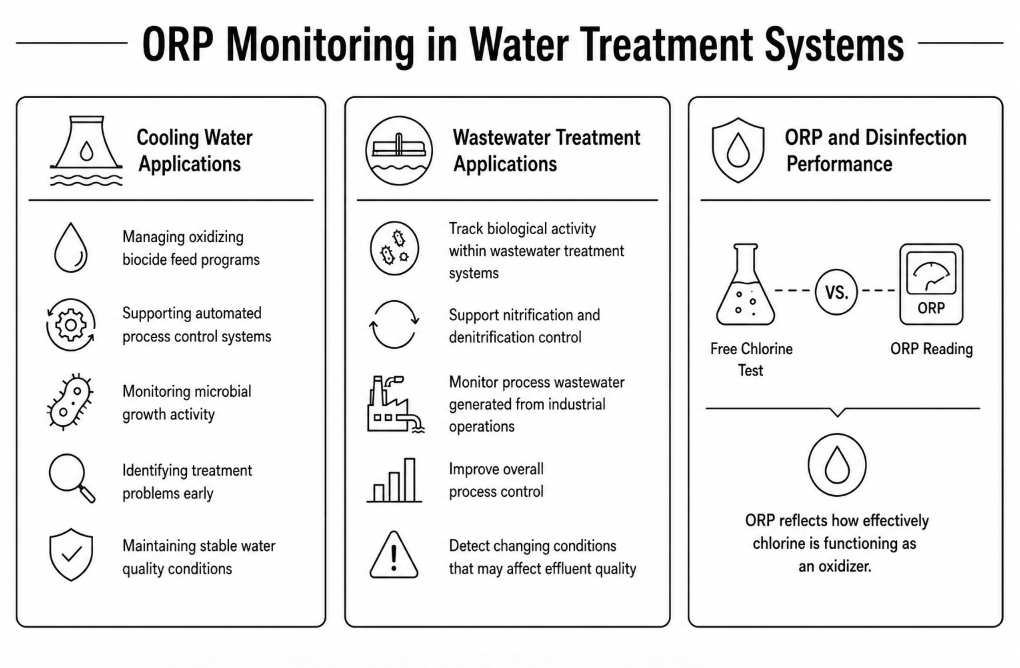
Cooling systems frequently use ORP monitoring to support microbiological control and maintain efficient operation. Because microbial growth can reduce heat transfer efficiency and contribute to fouling, operators often rely on ORP readings to evaluate whether oxidizing biocides are performing effectively.
Common cooling water applications for ORP monitoring include:
- Managing oxidizing biocide feed programs
- Supporting automated process control systems
- Monitoring microbial growth activity
- Identifying treatment problems early
- Maintaining stable water quality conditions
Since ORP measures oxidizing activity rather than simple chemical concentration, it can provide a more practical indication of treatment effectiveness in dynamic water systems.
Wastewater Treatment Applications
In wastewater treatment plants, monitoring ORP helps operators evaluate changing biological reactions throughout the treatment process. ORP measurement is commonly used to assess aerobic and anaerobic conditions, optimize nutrient removal, and maintain consistent effluent quality.
Operators may use monitoring ORP practices to:
- Track biological activity within wastewater treatment systems
- Support nitrification and denitrification control
- Monitor process wastewater generated from industrial operations
- Improve overall process control
- Detect changing conditions that may affect effluent quality
Because wastewater conditions constantly fluctuate, ORP monitoring provides valuable operational insight that complements other water quality parameters.
ORP and Disinfection Performance
One common misconception is that disinfectant concentration alone determines treatment effectiveness. In reality, ORP readings often provide a clearer picture of actual oxidizing performance within the system.
For example, free chlorine tests measure the amount of chlorine present in the water, while ORP reflects how effectively that chlorine is functioning as an oxidizer.
| Measurement | What It Indicates |
|---|---|
| Free chlorine | Amount of disinfectant present |
| ORP readings | Oxidizing effectiveness and treatment activity |
Other oxidizing agents, including chlorine dioxide and hydrogen peroxide, may also influence ORP levels depending on system chemistry and treatment objectives.
ORP Sensors, Probes, and Measurement Methods
Accurate ORP measurement depends on reliable instrumentation and consistent monitoring practices. In modern ORP water treatment programs, facilities commonly use inline ORP sensors and portable testing equipment to track changing oxidation conditions throughout the treatment process.
Because ORP readings can fluctuate based on water chemistry, temperature, and biological activity, proper sensor selection and maintenance are essential for dependable monitoring ORP performance.
How ORP Probes Work
An ORP probe measures the electrical potential created by oxidation and reduction reactions occurring in water. Most ORP probes contain an ORP electrode that detects electron exchange activity between oxidizing and reducing compounds within the system.
As oxidation activity increases, the measured electrical potential rises. When reducing conditions dominate, ORP levels decline. This allows operators to evaluate changing water conditions in real time and adjust treatment programs accordingly.
Common ORP Monitoring Tools
Facilities may use several types of ORP monitoring equipment depending on system size and operational requirements.
Common tools include:
- Inline ORP sensors for continuous process control
- Portable handheld ORP meters for field testing
- Automated ORP control systems integrated with chemical feed equipment
- Specialized ORP probes designed for wastewater or high-fouling environments
Continuous monitoring systems are often preferred in large water treatment systems because they provide real-time operational data and improve automation efficiency.
Factors That Affect ORP Measurement
Several variables can influence ORP measurement accuracy and stability, including:
- Temperature ORP fluctuations
- Organic matter accumulation
- Probe fouling or scaling
- Sensor calibration frequency
- Water chemistry variability
- Oxidizing agent concentration
Routine cleaning and calibration of ORP sensors help maintain accurate readings and support more reliable process control decisions.
ORP in Biological Wastewater Processes
In wastewater treatment plants, ORP monitoring is widely used to evaluate and control biological reactions throughout the treatment process. Because different microorganisms thrive under different oxidation conditions, ORP readings help operators maintain stable biological activity and improve overall process performance.
By monitoring oxidation reduction potential ORP, facilities can better manage nutrient removal, microbial growth, and sludge digestion while maintaining compliance with total nitrogen discharge limits and total phosphorus discharge limits.
Aerobic and Anaerobic Conditions
Different biological processes require different ORP conditions to function effectively. High ORP conditions typically support aerobic biological reactions, while low ORP environments promote anaerobic activity.
In an aerobic tank, nitrifying bacteria rely on dissolved oxygen and oxidizing conditions to convert ionized ammonia into nitrogen containing compounds that can later be removed from the system. As ORP increases, aerobic microbial activity generally becomes more stable and efficient.
Under low ORP conditions, anaerobic bacteria and methane forming bacteria become more active. These organisms are commonly found in anaerobic digesters, where fermentation occurs and methane production supports sludge stabilization processes.
| ORP Condition | Typical Biological Activity |
|---|---|
| High ORP | Aerobic biological reactions and nitrification |
| Moderate ORP | Transition conditions between aerobic and anaerobic activity |
| Low ORP | Anaerobic digestion, fermentation, and methane production |
Biological Phosphorus Removal
Many biological phosphorus removal systems rely on controlled ORP conditions to support phosphorus accumulating bacteria. These specialized microorganisms absorb and store phosphorus granules during alternating aerobic and anaerobic treatment stages.
During anaerobic phases, biological phosphorus release occurs as phosphorus accumulating bacteria metabolize stored compounds. Under subsequent aerobic conditions, these organisms absorb phosphorus again, helping reduce phosphorus concentrations within the waste stream.
Carefully monitoring biological reactions through ORP measurement helps operators maintain stable biological phosphorus removal performance and reduce the risk of process instability.
Nitrogen Removal and Effluent Quality
ORP monitoring also supports nitrogen removal by helping operators identify conditions favorable for nitrification and denitrification. As biological conditions shift throughout wastewater treatment systems, ORP readings provide insight into whether microorganisms are effectively converting nitrogen compounds into molecular nitrogen for removal.
Using ORP to Control Sulfides and Odors
Low ORP conditions in wastewater treatment systems and sewer systems can create an environment where anaerobic activity becomes dominant. When oxygen levels decline and reducing conditions develop, sulfate reducing bacteria may begin converting sulfur containing compounds into hydrogen sulfide gas. This process contributes to biological malodor production, corrosion concerns, and declining water quality.
Because ORP measures changing oxidation conditions within a waste stream, operators often use monitoring ORP practices to identify conditions that may lead to sulfide formation before odors and operational problems worsen.
Conditions That Promote Sulfide Formation
Several operating conditions can contribute to low ORP values and increased hydrogen sulfide generation, including:
- Stagnant wastewater flow conditions
- High organic loading within the waste stream
- Oxygen depletion
- Volatile acid formation
- Fatty acid production during anaerobic decomposition
- Extended retention times where fermentation occurs
As volatile acids and fatty acids accumulate, ORP levels often continue to decline, creating conditions favorable for additional sulfide formation and odor generation.
Strategies to Prevent Sulfide Formation
Facilities may use several ORP control strategies to prevent sulfide formation and maintain more stable wastewater conditions, including:
- Increasing aeration to improve oxidizing conditions
- Adding sodium nitrate to suppress sulfate reducing bacteria activity
- Improving wastewater circulation and mixing
- Monitoring biological reactions throughout the treatment process
- Adjusting treatment process conditions to maintain stable ORP levels
In many wastewater treatment applications, maintaining proper ORP control helps reduce odor complaints, improve operational reliability, and support more consistent effluent quality.
Technical Support for ORP Water Treatment Programs
Effective ORP water treatment programs require more than chemical selection alone. Long-term system performance depends on accurate monitoring, stable chemistry control, and the ability to respond to changing operating conditions across cooling systems, wastewater applications, and industrial process water environments.
ETI supports water treatment professionals, distributors, and OEMs with technical guidance and customized chemical solutions designed to improve process reliability and water quality management. Rather than competing with service providers, ETI operates as a technical and manufacturing partner, helping customers strengthen their own treatment programs with flexible support and specialized expertise.
ETI’s related capabilities include:
- Cooling water treatment programs for microbial control, corrosion prevention, and scale management
- Oxidizing and non-oxidizing biocide programs for cooling systems and wastewater treatment systems
- ORP control support for oxidizing chemistry applications involving chlorine-based and bromine-based treatments
- Wastewater treatment solutions including coagulants, flocculants, odor control, and bioaugmentation
- Advanced dispersant technologies that improve biocide performance and reduce fouling
- Technical troubleshooting, laboratory support, and water analysis services
- Custom chemical blending for application-specific treatment requirements
- Regulatory and application guidance for microbial control programs
Because ORP monitoring often works alongside broader water quality parameters and process control strategies, ETI helps customers evaluate treatment performance in relation to microbial growth, oxidizing conditions, and overall system stability.
Whether supporting cooling water operations, wastewater treatment plants, or industrial water systems, ETI provides technical expertise and customized chemical solutions that help water treatment professionals deliver reliable results to their customers.
For technical support related to ORP monitoring, microbial control, and water treatment program optimization, contact ETI to speak with their technical team.