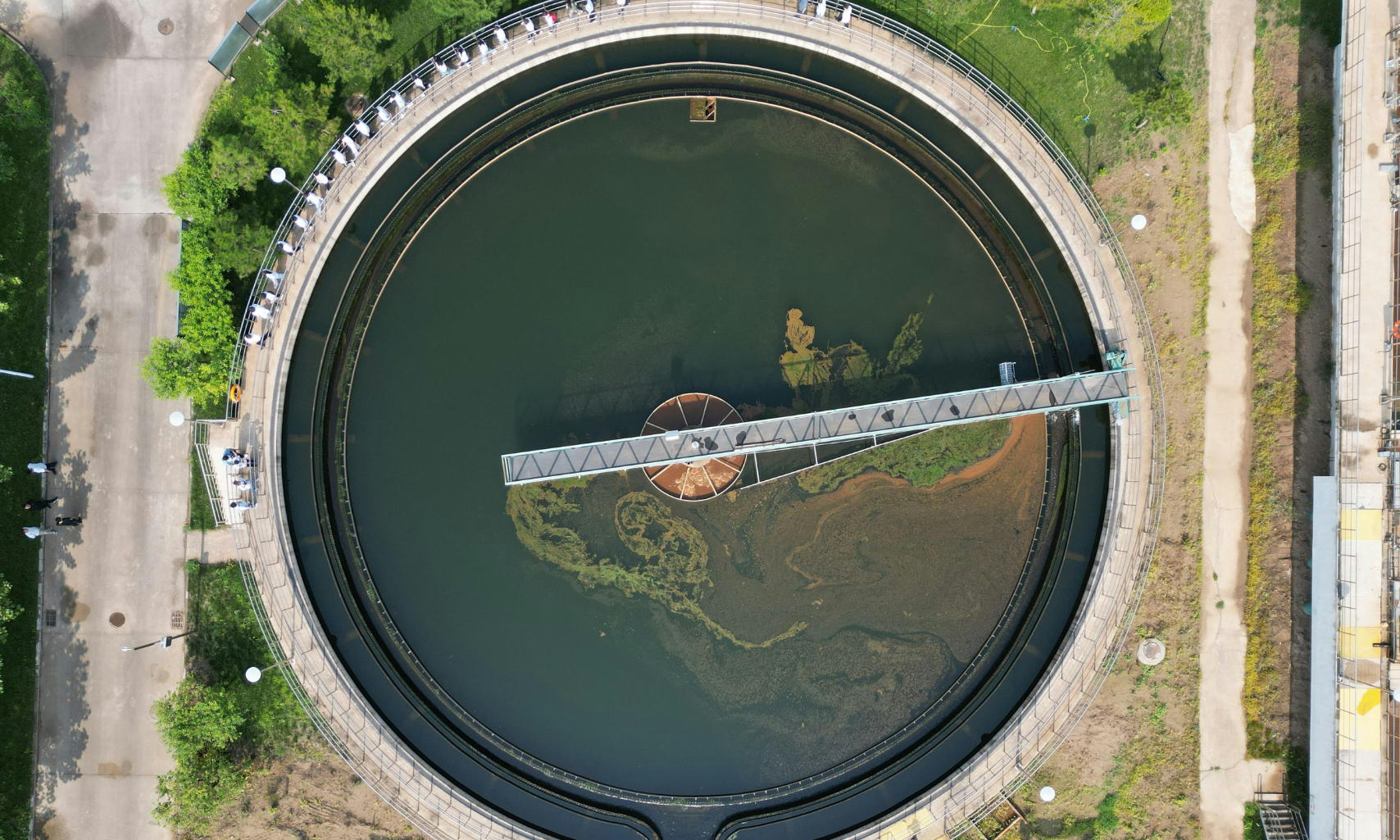
Water treatment systems rely on more than filtration equipment and mechanical processes to maintain performance and water quality. In many industrial and municipal operations, water treatment polymers play a critical role in improving the treatment process by helping remove suspended solids, organic matter, and other contaminants that reduce system efficiency. These specialized polymers are widely used in wastewater treatment, cooling systems, sludge handling, and clarification applications where effective solid-liquid separation is essential for producing clean water and maintaining operational reliability.
Modern industries face increasing pressure to improve treatment effectiveness, reduce waste, and comply with environmental regulations related to wastewater produced during industrial operations. As a result, polymer water treatment programs have become an important part of many industrial applications because they improve coagulation, flocculation, sedimentation, and filtration performance across a wide range of systems. From municipal plants to food processing facilities, properly selected polymers help operators manage impurities, separate solids more efficiently, and optimize overall treatment performance.
What Are Water Treatment Polymers?
Water treatment polymers are specialized chemical compounds made up of repeating monomer molecules linked together in a polymer chain. These chains form large molecules that interact with particles, contaminants, and dissolved materials in water to improve separation and treatment efficiency. Depending on their structure and specific properties, polymers can either cause particles to combine into larger flocs or keep unwanted materials dispersed to prevent deposits and fouling.
In polymer water treatment applications, the chemistry and molecular structure of the product determine how effectively it performs within a treatment process. Some polymers are designed to neutralize electrical charges on suspended solids, while others bridge smaller molecules together so they can be more easily separated through sedimentation or filtration. This is especially important in industrial wastewater treatment systems where contaminants, organic matter, clay, silt, oil, and sludge are commonly present.
How Polymers Function in Water Treatment
Most treatment polymers work by interacting with particles suspended in water. Many contaminants naturally repel each other because they carry similar electrical charges. Polymers help overcome this repulsion, allowing particles to combine into heavier masses that settle or filter more readily.
The effectiveness of this process depends on several factors, including:
- Water chemistry
- Particle size
- Polymer charge
- Mixing conditions
- Contact time
- Floc size requirements
- The concentration of organic solids and inorganic solids
Because treatment conditions vary widely across industries, polymer selection is typically tailored to the application and system requirements.
Common Forms of Water Treatment Polymers
Water treatment polymers are available in several forms depending on storage, feed, and application requirements:
- Liquid polymers, commonly used for continuous feed systems and rapid mixing applications
- Dry polymers, often preferred for long shelf life and lower shipping volume
- Emulsion polymers, designed for easier activation and handling in certain industrial processes
Natural vs. Synthetic Polymer Materials
| Polymer Type | Common Characteristics |
|---|---|
| Synthetic polymers | Engineered for targeted performance and consistent treatment effectiveness |
| Natural polymers | Derived from naturally occurring materials and used in select applications |
| Organic polymers | Commonly used in industrial and wastewater treatment operations |
Many modern synthetic polymers are specifically engineered to improve coagulation and flocculation performance while supporting cost savings, operational efficiency, and regulatory compliance across industrial applications.
Types of Water Treatment Polymers
Different water treatment systems require different polymer chemistries depending on the contaminants present, treatment objectives, and operating conditions. Water treatment polymers are typically categorized by their electrical charge and treatment function. Understanding these differences helps operators determine which products are most effective for a specific process.
Cationic Polymers
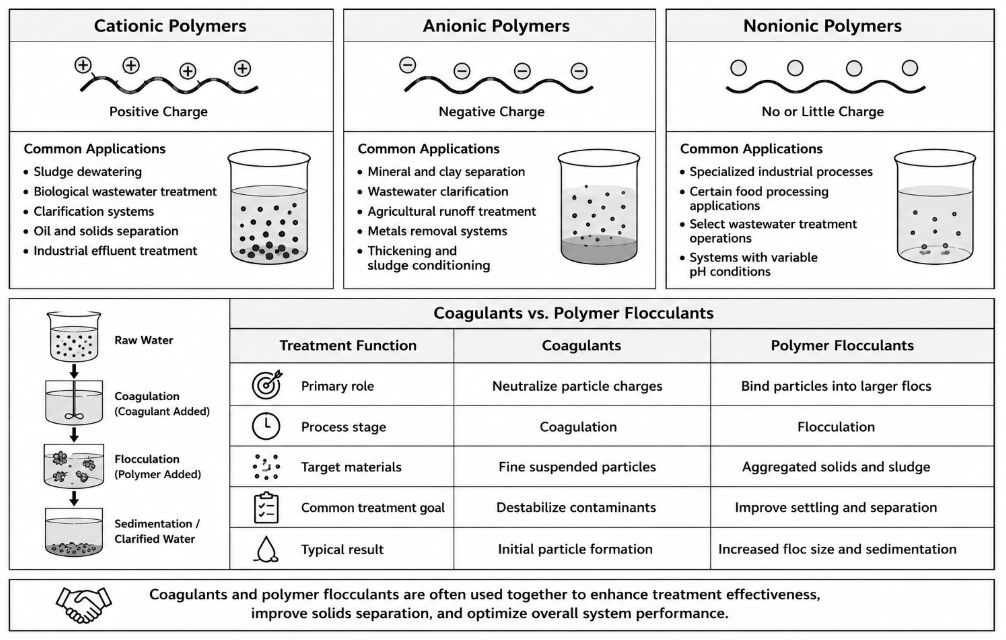
Cationic polymers carry a positive charge and are commonly used when negatively charged particles are present in water. These polymers are widely used in wastewater treatment because many organic contaminants, biological solids, and sludge particles naturally carry negative surface charges.
Common applications for cationic polymers include:
- Sludge dewatering
- Biological wastewater treatment
- Clarification systems
- Oil and solids separation
- Industrial effluent treatment
Some cationic polymers, including poly DADMAC formulations, are highly effective during the coagulation process because they rapidly neutralize particle charges and improve settling performance.
Anionic Polymers
Anionic polymers carry a negative charge and are commonly applied where positively charged particles or metal ions are present. These polymers are frequently used to improve flocculation and sedimentation in industrial and municipal treatment systems.
Typical uses for anionic polymers include:
- Mineral and clay separation
- Wastewater clarification
- Agricultural runoff treatment
- Metals removal systems
- Thickening and sludge conditioning
Anionic treatment polymers are often selected when larger flocs are needed for improved solids separation and filtration efficiency.
Nonionic Polymers
Nonionic polymers have little or no electrical charge and are used in applications where charge interaction is less important. These polymers can perform well in systems with varying chemistry or where delicate floc structures are required.
They are commonly used in:
- Specialized industrial processes
- Certain food processing applications
- Select wastewater treatment operations
- Systems with variable pH conditions
Coagulants vs. Polymer Flocculants
Although coagulation and flocculation are closely related, they serve different functions within a treatment process.
| Treatment Function | Coagulants | Polymer Flocculants |
|---|---|---|
| Primary role | Neutralize particle charges | Bind particles into larger flocs |
| Process stage | Coagulation | Flocculation |
| Target materials | Fine suspended particles | Aggregated solids and sludge |
| Common treatment goal | Destabilize contaminants | Improve settling and separation |
| Typical result | Initial particle formation | Increased floc size and sedimentation |
In many industrial applications, coagulants and polymer flocculants are used together to improve overall treatment effectiveness. The combination helps operators separate solids more efficiently, reduce impurities, and improve the overall performance of wastewater and water treatment systems.
Applications of Water Treatment Polymers Across Industries
Water treatment polymers are used across a wide range of industries because they improve separation efficiency, reduce operating costs, and support cleaner discharge and reuse processes. Their ability to enhance coagulation, flocculation, filtration, and sedimentation makes them valuable in both industrial and municipal treatment systems.
Industrial Wastewater Treatment
One of the most common uses for polymers is in industrial wastewater treatment. Manufacturing facilities often generate wastewater produced from cleaning operations, production processes, cooling systems, and material handling activities. This wastewater may contain suspended solids, oil, organic matter, toxic pollutants, metal ions, and sludge that must be treated before discharge or reuse.
Polymers help improve treatment performance by:
- Increasing solids separation
- Improving sludge dewatering
- Supporting oil and water separation
- Enhancing sedimentation rates
- Reducing contaminants in industrial effluent
Industries that commonly rely on polymer-based wastewater treatment programs include chemical manufacturing, metal processing, mining, pulp and paper, textiles, and food processing operations.
Municipal Plants
Municipal plants use treatment polymers to help produce clean water and maintain compliance with environmental regulations and drinking water standards. In these systems, polymers are commonly used during clarification and sludge handling processes to improve operational efficiency.
Common municipal applications include:
- Removal of suspended solids
- Improved filtration performance
- Sludge thickening and dewatering
- Enhanced coagulation and flocculation
- Reduction of organic contaminants
Because municipal wastewater systems process large volumes of waste daily, treatment effectiveness and cost savings are major operational priorities.
Cooling and Boiler Systems
In cooling towers and boiler systems, polymers are used to control deposits, disperse solids, and maintain system cleanliness. These systems often operate under conditions where scaling, fouling, and corrosion can reduce heat transfer efficiency and increase maintenance costs.
Certain organic polymers help keep particles separated and suspended so they can be removed before deposits form on heat transfer surfaces. Polymer programs may also improve the performance of other treatment chemicals within the system.
Typical applications include:
- Scale control
- Dispersing inorganic solids
- Iron and silt dispersion
- Fouling reduction
- Improved filtration efficiency
Food Processing Operations
Food processing facilities require reliable water treatment programs to support production quality, equipment cleanliness, and regulatory compliance. In these environments, polymers may be used to assist with wastewater clarification, solids removal, and sludge management.
Because food processing wastewater can contain high levels of organic solids, fats, oil, and suspended materials, properly selected polymers help improve separation processes while supporting environmental and operational goals.
Agricultural and Process Water Systems
Agricultural and industrial process water systems also use polymers to manage solids, improve water clarity, and reduce waste discharge issues. In some applications, polymers help separate clay, silt, and organic particles from water before reuse or discharge.
These treatment solutions are especially valuable where water conservation, pollutant reduction, and operational efficiency are important priorities across industrial applications.
Why Proper Polymer Selection Matters
Selecting the correct polymer is one of the most important factors in achieving consistent treatment performance. Even high-quality products can produce poor results if the chemistry, charge, or feed conditions are not properly matched to the application. Because every treatment process contains different contaminants, solids concentrations, and operating conditions, polymer selection should be based on system-specific evaluation rather than a one-size-fits-all approach.
Several factors help determine which polymers are most effective, including:
- The type of suspended solids present
- Organic and inorganic contaminant levels
- Water pH and chemistry
- Desired floc size
- Mixing intensity
- Sedimentation and filtration requirements
- Sludge handling objectives
The molecular structure of a polymer also affects how it performs. Some polymers produce stronger and larger flocs for rapid settling, while others are designed for improved dispersion or dewatering performance. In many wastewater treatment systems, achieving the right balance between coagulation and flocculation is critical for maximizing treatment effectiveness and reducing chemical consumption.
Common Problems Caused by Incorrect Polymer Selection
Improper polymer selection or feed control can create several operational challenges:
- Poor solids separation
- Reduced filtration performance
- Excess sludge production
- Increased chemical usage
- Carryover of impurities into downstream processes
- Reduced sedimentation efficiency
- Inconsistent treatment results
Overfeeding polymers may also cause sticky sludge, unstable floc formation, or additional waste handling problems. Underfeeding, on the other hand, can leave contaminants and suspended particles readily present in treated water.
Proper polymer optimization can provide several advantages, including improved process stability, lower operating costs, better compliance with wastewater regulations, and long-term cost savings. Because polymer programs directly impact water quality, equipment performance, and environmental compliance, they also play an important role in protecting human health and supporting sustainable industrial operations.
How ETI Supports Water Treatment Professionals
Effective polymer programs require more than product availability. Achieving consistent treatment performance often depends on proper chemical selection, system evaluation, dosing optimization, and ongoing technical support. Eastern Technologies, Inc. (ETI) supports water treatment professionals with customized chemical solutions and technical expertise designed to improve operational reliability across industrial and wastewater treatment systems.
For more than 38 years, ETI has operated as a chemical manufacturer and technical partner serving independent water treatment companies, distributors, and OEMs. Unlike many large providers, ETI does not compete directly for end users. Instead, the company focuses on helping partners strengthen their own service capabilities through flexible manufacturing, technical guidance, and application-specific support.
Customized Polymer and Wastewater Treatment Solutions
ETI provides a broad range of wastewater treatment and polymer water treatment solutions designed for industrial and municipal applications, including:
- Coagulants for clarification, suspended solids removal, and metal precipitation
- Cationic polymers and anionic polymers for sludge dewatering and flocculation
- Liquid polymers, dry polymers, and emulsion polymers for varying feed and operational requirements
- Polymer flocculants for DAF systems, oil and water separation, and industrial effluent treatment
- Advanced dispersants for cooling systems, boilers, and wastewater applications
- Heavy metal removal programs and oil treatment solutions
- Bioaugmentation products for improving biological wastewater treatment performance
ETI also supports cooling and boiler treatment programs with polymer-based dispersants, antiscalants, corrosion inhibitors, oxygen scavengers, and custom blended chemical formulations designed for demanding operating conditions.
Technical Support and Program Optimization
Because every treatment process has unique chemistry and operating conditions, ETI emphasizes hands-on technical support and program optimization. Support services may include:
- Jar testing and laboratory analysis
- Field trials and troubleshooting
- Dosing system recommendations
- Water chemistry evaluations
- Operator training and technical guidance
- Regulatory and documentation assistance
Whether addressing wastewater treatment challenges, improving filtration efficiency, or optimizing industrial water treatment polymers for a specific application, ETI works as a long-term technical partner focused on helping water treatment professionals deliver dependable results.
For support with polymer selection, wastewater treatment optimization, or custom water treatment chemical programs, contact ETI to discuss your system requirements and treatment goals.