Mineral scale can develop when dissolved salts exceed their solubility limits in industrial water systems. Deposits on heat transfer surfaces and piping can restrict fluid flow, reduce heat transfer efficiency, and increase maintenance requirements. Effective scale control is therefore essential for protecting equipment and maintaining reliable system performance.
Specialized threshold inhibition scale inhibitors work by interfering with mineral precipitation at relatively low concentrations. Rather than removing dissolved minerals, these chemical additives disrupt crystal formation and growth, helping reduce scale deposition in applications such as cooling towers and reverse osmosis systems. Understanding how these inhibitors function and what influences their effectiveness helps water treatment professionals develop more reliable treatment programs.
Key Takeaways
- Threshold inhibition helps prevent mineral scale by interfering with crystal nucleation and growth, rather than removing dissolved minerals or existing deposits.
- Effective scale inhibitor selection depends on mineral composition, water chemistry, operating conditions, and compatibility with the overall treatment program.
- Consistent chemical dosing, performance monitoring, and technical support help water treatment professionals maintain effective scale control, protect equipment, and improve system efficiency.
Why Mineral Scale Forms in Water Systems
Mineral scale forms when dissolved ions in water become supersaturated and begin to precipitate as solid crystals. Changes in temperature, pH, evaporation, and mineral concentration can increase scaling risk. As crystals develop, they may attach to equipment surfaces and accumulate into deposits.
Common Scale-Forming Minerals
Calcium carbonate is a common source of mineral scale in cooling towers and other circulating water systems. It can precipitate when changing water conditions reduce its effective solubility. Calcium sulfate is another concern, particularly in highly concentrated waters. Both are sparingly soluble salts, although their precipitation behavior and treatment requirements differ.
How Scale Affects Equipment Performance
Scale deposits on heat transfer surfaces create resistance to heat flow, potentially increasing energy consumption. Accumulation inside pipes and heat exchangers can also restrict fluid flow and increase pressure drop.
Over time, scale buildup can reduce system efficiency, increase maintenance requirements, and contribute to equipment downtime. Understanding the minerals involved and the conditions driving scale formation is essential for selecting effective treatment strategies.
What Is Threshold Inhibition?
Threshold inhibition is a scale control mechanism in which small amounts of treatment chemicals delay mineral precipitation in water. Under supersaturated conditions, calcium carbonate and other sparingly soluble salts can form solid crystals. Threshold inhibitors interfere with this process, helping dissolved minerals remain in solution longer than they would without treatment.
Unlike conventional sequestration, which relies on binding dissolved ions in proportion to their concentration, threshold inhibition scale inhibitors can work at concentrations much lower than those of scale-forming ions. These chemical additives can delay the formation of crystal nuclei, interact with developing crystal surfaces, and slow further crystal growth. This extends the induction period before measurable precipitation occurs.
However, threshold inhibition does not remove dissolved minerals or permanently eliminate scale formation. Its effectiveness depends on inhibitor concentration, mineral composition, water chemistry, temperature, and operating conditions. A properly designed treatment program combines suitable inhibitor chemistry with consistent chemical dosing and monitoring to reduce scaling risk and maintain system performance.
How Threshold Inhibition Works
Threshold inhibitors act during the early stages of mineral crystallization. Their effects depend on inhibitor chemistry, the type of mineral, and operating conditions within the water system.
1. Interference With Crystal Nucleation
When dissolved ions create a supersaturated solution, tiny clusters can develop into stable crystal nuclei. Certain scale inhibitors interact with these early clusters or newly forming surfaces, delaying nucleation. Fewer stable nuclei may mean fewer opportunities for calcium carbonate or other minerals to develop into deposits on equipment.
2. Blocking Active Crystal Growth Sites
Once crystals begin forming, inhibitor molecules can adsorb onto active crystal growth sites, such as steps and edges on the crystal surface. By occupying these sites, they interfere with the attachment of additional mineral ions. This slows further crystal growth without removing the dissolved hardness responsible for the original scaling risk.
3. Crystal Modification and Distortion
Adsorption may occur unevenly across different crystal faces, altering their growth rates. This can change crystal morphology, producing distorted or less adherent particles instead of hard, tightly bonded scale deposits. Crystal modification often accompanies threshold inhibition, although its importance depends on the chemical formulation and the mineral being controlled.
4. Delaying Mineral Precipitation
Together, nucleation interference and growth inhibition extend the induction period before measurable precipitation occurs. In cooling towers and other circulating water systems, this delay can reduce scale deposition during normal operating cycles. It is not permanent prevention: high supersaturation, inadequate inhibitor concentration, or extended residence time may still allow mineral scale to develop.
Common Types of Scale Inhibitors
Scale inhibitors are selected according to the minerals present, operating conditions, and treatment objectives. Commercial scale inhibitors commonly rely on phosphonates, water-soluble polymers, or blended formulations. Each category can affect mineral crystallization differently, so chemical selection should reflect the particular scaling risk.
| Inhibitor Type | How It Works | Key Considerations |
|---|---|---|
| Phosphonates | Organic phosphorus compounds can adsorb onto developing mineral crystals and slow their growth at low concentrations. | Used for calcium carbonate and certain sulfate scales; performance depends on water chemistry. |
| Polymeric Inhibitors | Polyacrylates and related copolymers can modify crystal growth and disperse fine particles before they accumulate. | Polymer structure, temperature, and the target mineral influence effectiveness. |
| Specialty Formulations | Combine compatible phosphonates, polymers, or other chemical additives for multiple deposit-control needs. | Blends must be matched to system conditions and other treatment chemicals. |
Many synthetic scale inhibitors are organic compounds, although not all organic formulations behave alike. Some polymeric scale inhibitors emphasize crystal growth control, while others provide stronger particle dispersion. For example, an inhibitor effective against calcium carbonate scaling may not offer equivalent protection against calcium sulfate.
The best choice depends on water analysis, mineral supersaturation, pH, temperature, and compatibility with the broader treatment program. No single formulation controls every type of mineral scale.
Threshold Inhibition vs. Other Scale Control Mechanisms
Not all scale control chemicals function alike. Threshold inhibition delays mineral precipitation, while other mechanisms alter crystal structure, keep particles suspended, or bind dissolved ions. These actions may overlap in multifunctional formulations.
| Mechanism | How It Works | Main Role |
|---|---|---|
| Threshold Inhibition | At low concentrations, inhibitors interfere with crystal nucleation and growth. | Delays the formation of scale crystals. |
| Crystal Modification | Molecules adsorb unevenly onto growing crystal surfaces, changing crystal morphology. | Reduces the tendency for hard, adherent deposits. |
| Dispersion | Polymers help keep fine mineral particles separated and suspended. | Limits particle agglomeration and deposition on equipment surfaces. |
| Sequestration | Chelating agents bind dissolved metal ions into soluble complexes. | Reduces free ions available for precipitation, generally requiring amounts related to ion concentration. |
In practice, the same inhibitor may provide more than one function. Phosphonates often act through threshold inhibition and crystal modification, while polymers may combine inhibition with dispersion. Effective scale control therefore depends on matching the formulation to the mineral species, water chemistry, and operating conditions rather than relying on a single mechanism.
Applications of Threshold Inhibition in Industrial Water Treatment
Threshold inhibitors are used where dissolved minerals can precipitate as operating conditions change. Their suitability depends on the scaling tendency of the water and the demands of each treatment system.
Cooling Towers and Heat Exchangers
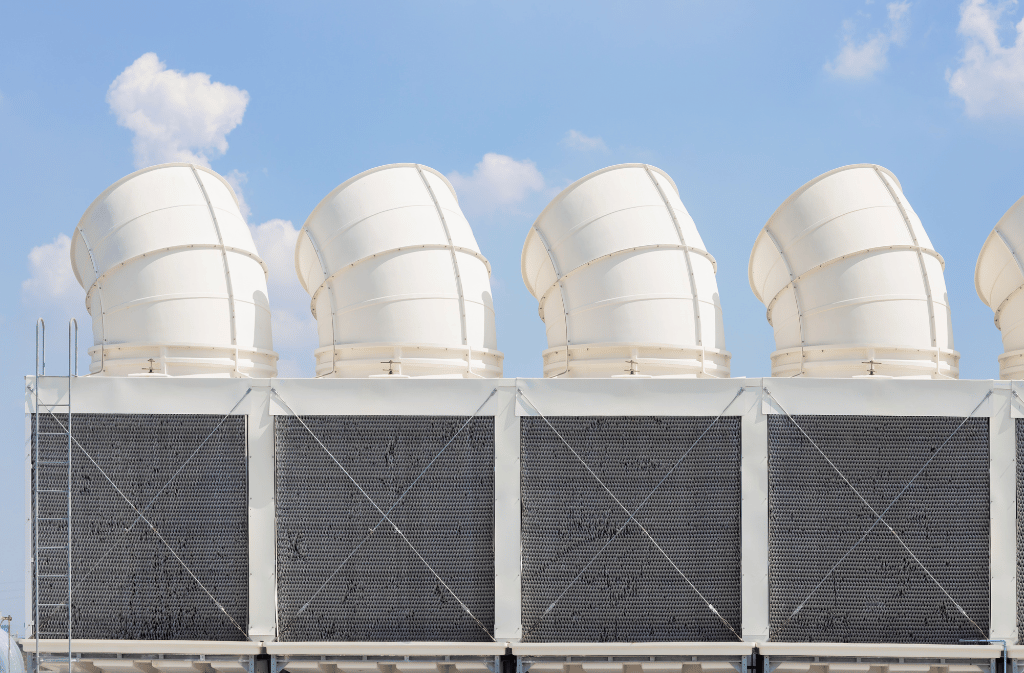
Evaporation in cooling towers concentrates dissolved salts, increasing the risk of calcium carbonate scale deposition. Heat exchangers are especially vulnerable because deposits on heat transfer surfaces restrict thermal performance. Phosphonate and polymer-based treatment programs can delay carbonate scale formation, helping maintain heat transfer efficiency and reduce cleaning requirements. Treatment must also account for cycles of concentration, water temperature, and chemical compatibility.
Reverse Osmosis Systems
In reverse osmosis systems, dissolved minerals become concentrated near membrane surfaces and in the reject stream. This can encourage carbonate scales and sulfate scales, including calcium sulfate, that reduce membrane performance and increase pressure drop. Appropriate antiscalants help delay precipitation, but their effectiveness depends on feedwater chemistry, recovery rate, and consistent dosing. They do not replace pretreatment or membrane cleaning when needed.
Industrial Process and Boiler Water Systems
Process water circuits may use threshold inhibitors to limit deposits on piping and equipment surfaces, protecting flow and system efficiency. Boiler scale control also uses specialized chemistry, although many phosphate-based boiler programs intentionally precipitate hardness and disperse the resulting solids rather than relying primarily on threshold inhibition. The treatment approach must reflect boiler pressure, feedwater purity, and operating conditions.
Factors Affecting Scale Inhibitor Performance
The effectiveness of threshold inhibition scale inhibitors depends on water chemistry, mineral concentration, and operating conditions. A formulation that performs well in one system may provide limited protection in another.
- Mineral Composition and Scaling Tendency: Identify dissolved minerals and evaluate supersaturation levels. Calcium carbonate, calcium sulfate, and other sparingly soluble salts have different precipitation behaviors and inhibitor requirements.
- Water pH, Temperature, and Concentration: Changes in pH, temperature, and dissolved salt concentrations influence mineral solubility. Evaporation, heating, or higher membrane recovery can increase scaling risk and affect inhibitor performance.
- Minimum Effective Inhibitor Concentration: Determine the appropriate inhibitor concentration through water analysis and application-specific testing. Insufficient dosing may allow scale formation, while excessive dosing increases treatment costs without guaranteeing better results.
- Chemical Compatibility: Evaluate interactions with corrosion inhibitors, biocides, and other treatment chemicals. Incompatible formulations may reduce inhibitor effectiveness or contribute to unwanted precipitation.
- Application Method and Treatment Consistency: Ensure chemical feed systems provide adequate mixing and consistent dosing. Monitor flow rates, inhibitor residuals where measurable, and changing operating conditions to maintain effective scale control.
Regular evaluation helps water treatment professionals optimize inhibitor performance and maintain reliable system efficiency.
Evaluating and Monitoring Scale Inhibition
Evaluating scale inhibition requires comparing anticipated scaling conditions with actual system performance. Water analysis identifies hardness, alkalinity, pH, and other factors influencing precipitation. Laboratory screening can compare candidate chemistries, but results should be validated against operating conditions.
A practical monitoring checklist includes:
- Track pH, temperature, conductivity, hardness, and cycles of concentration where relevant.
- Verify chemical feed rates and inhibitor residuals when reliable analytical methods are available.
- Inspect equipment and analyze deposits to distinguish mineral scale from other fouling.
- Monitor pressure drop, flow, and heat transfer performance for signs of deposition.
These observations help assess whether scale inhibitors work consistently and whether dosing or operating adjustments are needed. In cooling towers and other industrial water systems, changes in makeup water quality and operating load can affect scale control. Because deposition develops over time, trend analysis generally provides stronger evidence than a single water sample or inspection.
ETI Scale Control Solutions and Technical Support
Effective scale control requires appropriate chemistry and reliable technical expertise. Eastern Technologies, Inc. (ETI) supports water treatment professionals and OEMs with cooling tower chemical treatments, including phosphonate formulations that use threshold inhibition and crystal modification. Its advanced dispersant technologies complement scale inhibitors by limiting particle deposition, while membrane treatments include preventive antiscalants.
For challenging applications, ETI offers custom chemical blending tailored to specific water chemistry and operating conditions. Its technical services provide application guidance and troubleshooting, supported by laboratory analysis of water and deposits. ETI works exclusively through its distributor partners rather than competing for end-user customers.
Need assistance selecting scale inhibitors or optimizing a treatment program? Contact ETI to discuss formulation options and technical support that help your water treatment business deliver dependable results.
Frequently Asked Questions (FAQs)
What is the difference between threshold inhibition and scale removal?
Threshold inhibition delays new mineral precipitation and crystal growth. Scale removal targets existing deposits on equipment surfaces.
How do threshold scale inhibitors prevent calcium carbonate scaling?
Threshold inhibition scale inhibitors interfere with crystal nucleation and growth. They do not remove dissolved calcium from water.
Can threshold inhibitors control calcium sulfate and other sulfate scales?
Some formulations inhibit calcium sulfate and other sulfate scales. Effectiveness depends on mineral chemistry, supersaturation, and operating conditions.
What factors determine the minimum effective scale inhibitor concentration?
The required concentration depends on water chemistry, temperature, and supersaturation. Testing helps establish an appropriate chemical feed rate.
How do water treatment professionals verify that scale inhibitors are working?
Professionals monitor water chemistry, chemical dosing, deposits, and equipment performance. Laboratory testing and field trends help evaluate treatment effectiveness.