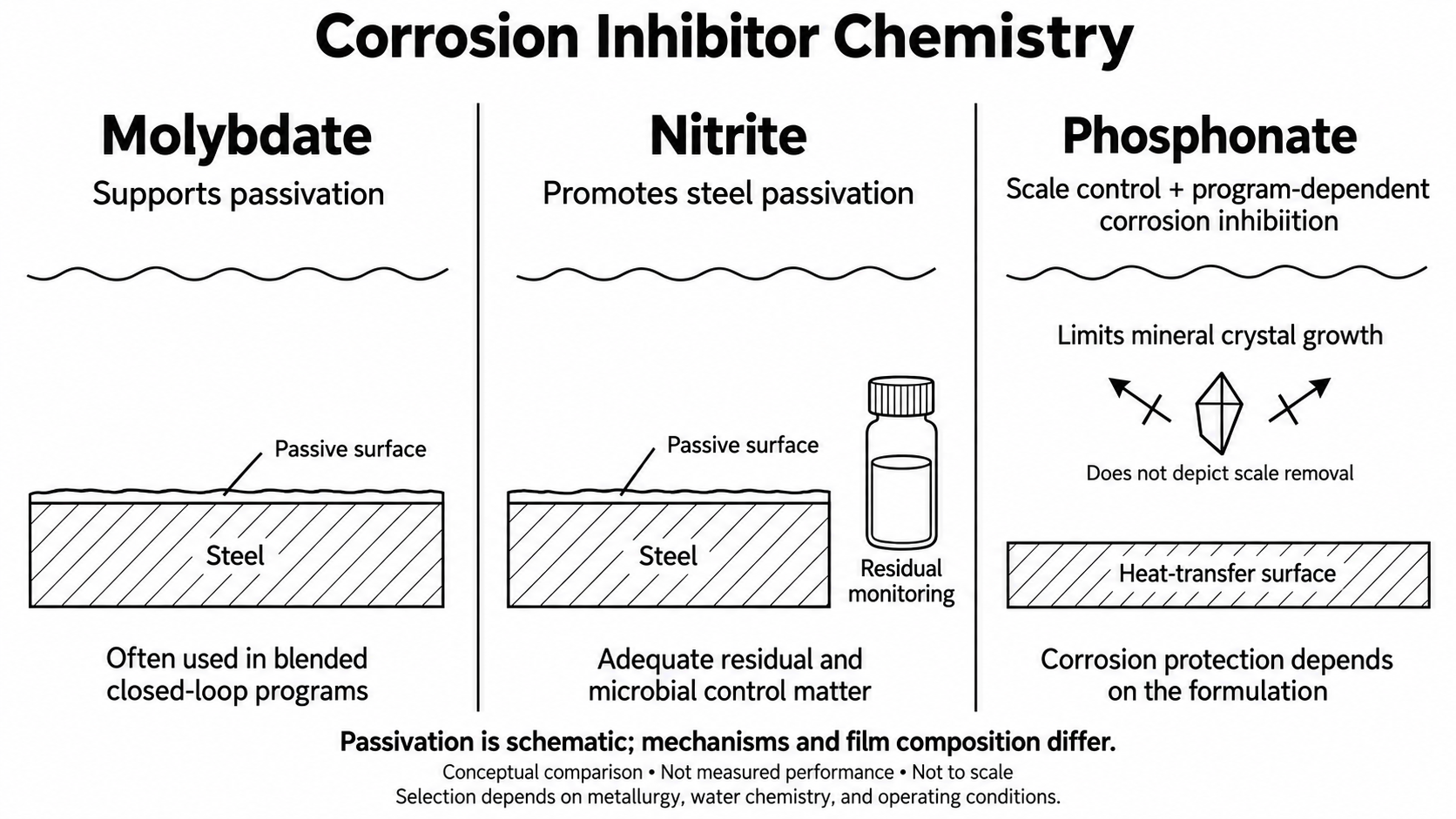
Corrosion inhibitor chemistry influences how effectively a water treatment program protects metal components under changing operating conditions. Molybdate, nitrite, and phosphonate each have a role in industrial applications, but their mechanisms, treatment requirements, and contributions to corrosion control differ.
For independent water treatment professionals, distributors, and OEMs, selecting corrosion inhibitors starts with understanding system metallurgy, water chemistry, and operating demands. A formulation suited to a closed cooling loop may not be appropriate for an open recirculating system. Understanding how these chemistries function, where they fit, and how to evaluate their performance helps professionals develop treatment programs that support equipment reliability while managing corrosion, scale, and fouling together.
Key Takeaways
- Molybdate, nitrite, and phosphonate have different functions and should not be treated as interchangeable.
- Match the complete formulation to metallurgy, water chemistry, operating conditions, and treatment compatibility.
- Verify protection through residual testing, corrosion measurements, and inspections, using ETI’s technical and laboratory support to inform application decisions.
How Corrosion Develops in Water Systems
Corrosion in water systems is an electrochemical process involving linked reactions at anodic and cathodic sites. At the anode, an oxidation reaction releases metal ions into the water and electrons into the metal. At the cathode, a reduction reaction consumes those electrons, often involving dissolved oxygen in aerated cooling water.
Together, these sites, the conducting metal, and the water form a corrosion cell. Electrical current flows through the circuit, carried by electrons in the metal and ions in the water. Corrosive agents and conditions, including dissolved oxygen, acidity, and elevated chloride concentrations, influence the rate and location of attack.
Three common types of corrosion illustrate why treatment requires more than checking for visible rust:
- Uniform corrosion causes relatively even metal loss across an exposed surface.
- Pitting corrosion concentrates damage in small areas, potentially causing penetration despite limited overall metal loss.
- Galvanic corrosion occurs when dissimilar metals are electrically connected and contact a shared electrolyte, accelerating attack on the more active metal.
Identifying the corrosion mechanism helps professionals evaluate inhibitor selection alongside deposits, flow conditions, and equipment design.
How Corrosion Inhibitors Protect Metal Surfaces
Different types of corrosion inhibitors reduce the rate of electrochemical reactions through mechanisms that depend on the chemistry and metal surface involved. Some promote passivation, while others produce deposits or adsorbed layers that interfere with corrosion reactions.
- Anodic inhibitors suppress metal dissolution, often by supporting a passive protective film. Their effectiveness depends on maintaining suitable water conditions and adequate inhibitor concentrations; insufficient protection can leave areas vulnerable to localized attack.
- Cathodic inhibitors slow the reduction reaction. Certain chemistries form a protective layer at cathodic sites, restricting access by species involved in that reaction.
- Combined programs address both processes through complementary ingredients. A formulation may also include metal-specific inhibitors, scale control agents, and dispersants to support protection across the system.
Film formation does not mean that all inhibitors create the same physical barrier or work immediately. Effective inhibition requires appropriate surface conditions, chemical distribution, and ongoing monitoring to confirm that the treatment remains suitable as operating conditions change.
Molybdate: Supporting Passivation in Formulated Programs
How It Works
Molybdate compounds are used in corrosion control programs, particularly for closed-loop water systems. They help establish and stabilize passive conditions on a steel surface, reducing metal dissolution when the surrounding water chemistry supports protection.
Their performance depends on the complete formulation and operating environment. Dissolved oxygen can play an important role in molybdate-based passivation, while a combination with nitrite can provide complementary protection. Different inhibitors are therefore often blended to address conditions that a single ingredient may not adequately control.
Molybdate-containing programs can help form protective films, but molybdate should not be described as creating a universal coating that protects every metal equally.
Monitoring should combine the appropriate inhibitor test with corrosion measurements and water chemistry trends. Molybdate is sometimes included in treatment additives as a tracer, so a detectable residual does not, by itself, demonstrate that enough active corrosion protection is present or that other formulation components remain at their intended concentrations.
Nitrite: Passivation and Residual Control
Nitrite is an anodic inhibitor commonly used to protect iron and steel in closed-loop water systems. It promotes oxidation of iron species at the surface, supporting a passive oxide film that slows further metal dissolution. Unlike some passivating treatments, nitrite does not depend on dissolved oxygen alone to establish protection.
Its effectiveness requires sufficient inhibitor relative to the system’s corrosive conditions. Chloride and sulfate concentrations, pH, temperature, and metallurgy influence the treatment requirements. A nitrite program formulated for steel should not automatically be assumed to protect copper alloys or aluminum.
Maintaining an adequate nitrite residual is essential. If protection becomes incomplete, exposed anodic areas can experience localized attack even while much of the surface remains passive. Treatment limits should therefore follow the selected formulation’s guidance and application assessment rather than a universal dosage.
Microbial activity can also deplete nitrite, reducing the available inhibitor and complicating corrosion control. A falling residual warrants investigation into biological activity, leaks, makeup water dilution, and other chemical demands before simply increasing feed.
Phosphonate: Corrosion Control Within a Balanced Program
Phosphonates are used in cooling water treatment as scale inhibitors and, in suitable formulations, contributors to corrosion control. Their ability to interfere with mineral crystal growth helps limit deposits that can restrict heat transfer and create conditions for localized corrosion.
In corrosion inhibitor chemistry, their function depends on the specific compound and its interaction with other treatment ingredients. Phosphonate-based programs may combine these compounds with zinc or other corrosion inhibitors, supported by polymers that help control deposition. Scale inhibition alone should not be taken as evidence of adequate metal protection.
Phosphonates and inorganic phosphates are chemically distinct. Although both may appear in a cooling water formulation, their treatment roles and analytical measurements should not be treated as interchangeable.
Monitoring should evaluate corrosion, deposit formation, and the relevant chemical residuals together. A total phosphorus result alone cannot establish how much functional phosphonate remains available. Product-specific testing and operating trends help professionals determine whether the program is maintaining its intended balance between scale control and corrosion inhibition.
Comparing Molybdate, Nitrite, and Phosphonate
These three chemistries serve different purposes within a treatment program. Comparing corrosion inhibitor chemistry requires considering the complete formulation, system metallurgy, and operating environment rather than treating individual ingredients as direct substitutes.
| Chemistry | Typical role | Application context | Key consideration |
|---|---|---|---|
| Molybdate | Supports passivation and corrosion inhibition, often alongside complementary inhibitors. | Closed-loop programs, including appropriately formulated mixed-metal treatments. | Protection depends on water conditions and the blend; a tracer-level residual does not establish adequate inhibition. |
| Nitrite | Promotes a passive oxide film on iron and steel. | Closed-loop systems with controlled chemistry and monitored inhibitor levels. | Inadequate residuals can leave localized areas vulnerable; microbial activity may deplete nitrite. |
| Phosphonate | Controls scale and contributes to corrosion protection in suitable formulations. | Open recirculating cooling programs and other application-specific treatments. | Performance depends on the compound, companion ingredients, calcium compatibility, and operating conditions. |
Several types of inhibitors may be combined to protect equipment containing different metals. Selection should therefore consider each ingredient’s function, its required chemical residual, and how the finished program will be monitored. No single chemistry is the best choice for every system.
Selecting and Monitoring a Treatment Program
The choice of corrosion inhibitor depends on many factors, including metallurgy, water quality, and operating demands. Effective corrosion inhibitor chemistry must suit the entire system, with monitoring that evaluates both treatment levels and actual metal protection.
- Metallurgy: Identify steel, copper alloys, aluminum, and other wetted materials. Check product compatibility and whether different metals require complementary inhibitors or tighter pH control.
- Water and operating conditions: Review pH, dissolved oxygen, conductivity, chlorides, hardness, and makeup water requirements. High temperature, stagnant areas, and process contamination can change corrosion risks and treatment demands.
- Treatment compatibility: Evaluate interactions with biocides, scale inhibitors, dispersants, and existing deposits. Confirm that the proposed formulation remains suitable during startup, routine operation, and foreseeable system changes.
- Performance verification: Combine chemical residual testing with corrosion coupons, equipment inspections, and suitable electrochemical measurements. Compare findings over time under documented conditions.
Coupon weight loss provides an average corrosion rate over the exposure period, but that average can conceal localized damage. Inspect coupons for pitting and deposits, and recognize that their conditions may differ from those at operating heat-transfer surfaces.
These methods help determine whether adjustments are needed. A cost-effective program balances chemical use with verified protection, maintenance requirements, and equipment reliability.
How ETI Supports Corrosion Control Programs
ETI supports independent water treatment companies, distributors, and OEMs with chemical manufacturing and application expertise. Its Cooling & Boiler Treatments include formulations combining corrosion inhibitors, antiscalants, and dispersants for open recirculating, closed-loop, process, and once-through cooling applications. Custom formulation capabilities help partners address specific water conditions and equipment requirements when selecting corrosion inhibitor chemistry.
Through Technical Services, ETI provides application guidance, troubleshooting, and field support. Its Laboratory Services include water analysis, deposit analysis, and corrosion coupon analysis, helping partners evaluate treatment performance alongside their field observations. Historical results support trend review, and reports can be presented on the partner’s letterhead. Together, these resources help professionals investigate corrosion concerns and develop recommendations supported by operating data. Product selection and control targets remain specific to the formulation and application. ETI works through distributor partners and does not sell directly to end users, supporting the companies responsible for their customers’ treatment programs.
Contact ETI Water to discuss your application and strengthen your corrosion control program with formulation expertise and technical support.
Frequently Asked Questions (FAQs)
Are corrosion inhibitors the same as protective coatings?
Corrosion inhibitors are treatment additives that reduce corrosion through interactions with the metal, the surrounding liquid, or both, whereas a coating is generally applied directly to create a physical barrier. Some inhibitors form a protective layer during operation, but that layer should not be assumed to provide the durability or coverage of a separately applied coating.
Can one inhibitor protect every metal in a mixed-metal system?
A single ingredient should not be assumed to protect steel, copper alloys, and aluminum equally, because each material responds differently to water chemistry and treatment conditions. Systems containing dissimilar metals require assessment of galvanic corrosion and other types of corrosion, including selective leaching where susceptible alloys are present.
How do oxygen ingress and acidic contamination affect inhibitor performance?
Air entry can introduce oxygen, while acid contamination can change pH and destabilize protective surface conditions, increasing the demands on an existing inhibitor program. The effect depends on the fluid, metallurgy, and treatment chemistry, so professionals should investigate the source of the change alongside residual testing and corrosion measurements.
Do molybdate, nitrite, and phosphonate all work through a polar head?
The polar head description is useful for certain surface-active organic inhibitor molecules, but it does not adequately explain every mechanism involved in molybdate, nitrite, or phosphonate treatment. These chemistries can influence passivation, surface interactions, or deposit formation, depending on the compound and formulation, rather than all forming an identical molecular barrier.
Do shutdown systems need the same protection as operating systems?
Long term storage and shutdown change circulation, moisture exposure, and oxygen entry, so operating treatment conditions may not provide suitable protection for idle equipment and pipelines. ETI’s layup offerings can support a separate assessment of wet, dry, or vapor-phase protection based on system configuration, exposed materials, and the planned shutdown duration.