Deposits in cooling water systems can restrict flow, contribute to corrosion, and cause reduced heat transfer efficiency. For independent water treatment professionals, selecting the dispersants cooling water programs need starts with understanding the particles present and the conditions that allow them to accumulate.
In cooling towers, dispersants help limit particle aggregation and deposition as part of a coordinated cooling water treatment program. Understanding their capabilities, limitations, and application requirements helps professionals support reliable operation while addressing the fouling problems that can increase their customers’ operating costs.
Key Takeaways
- Match dispersant chemistry to the foulant, water chemistry, and operating conditions.
- Coordinate dispersion with solids removal, scale inhibition, corrosion protection, and microbial control.
- Verify performance through water testing, deposit observations, and operating trends, with ETI supporting your team’s application decisions.
How Dispersants Work
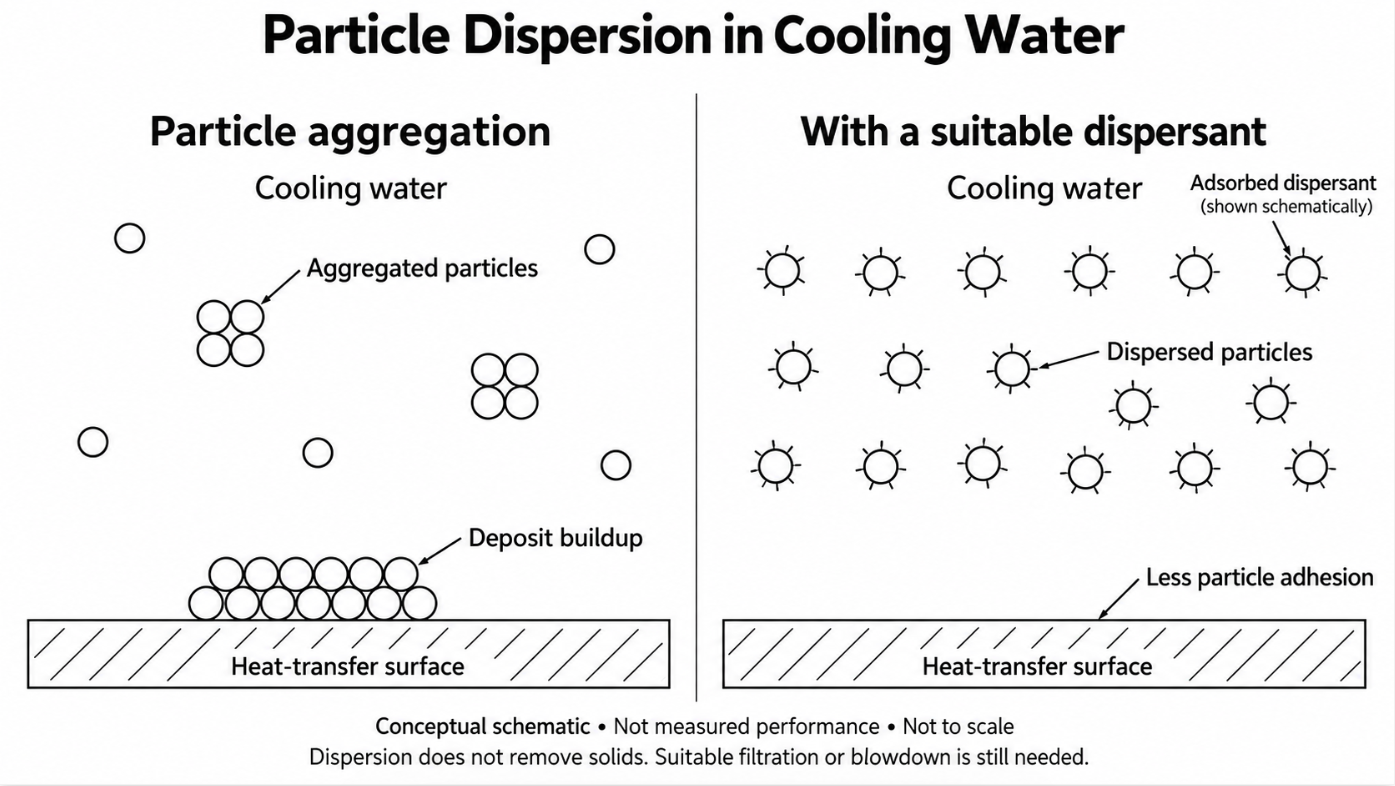
Dispersants work by adsorbing onto suspended particles and changing their surface properties. Many polymer dispersants increase electrostatic repulsion between particles, helping prevent them from clumping together. They also reduce the tendency of particles to adhere to heat exchange surfaces, where deposits can interfere with heat transfer.
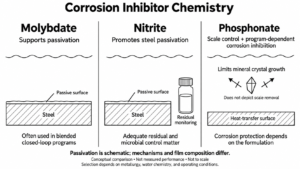
Dispersion differs from scale inhibition. Scale inhibitors interfere with the precipitation and crystal growth of dissolved minerals, such as calcium carbonate. Dispersants primarily help control particulate deposition, although some water treatment agents perform both functions within a formulated program.
Keeping particles dispersed does not remove them from the system or guarantee that existing mineral deposits will dissolve. Effective treatment also requires an appropriate solids removal strategy, such as blowdown or suitable filtration, coordinated with circulation and the overall deposit control program.
Different Fouling Challenges Require Different Approaches
Choosing the dispersants cooling water applications require begins with identifying the foulant. Suspended solids, organic contamination, and biological deposits can occur together, but each calls for a different treatment approach.
| Fouling challenge | Dispersant role | Complementary treatment |
|---|---|---|
| Suspended solids, including silt and corrosion products | Polymeric dispersants help keep particles separated and limit deposition. | Suitable filtration, blowdown, and corrosion inhibitors address solids accumulation and corrosion. |
| Organic fouling from oils and other organic matter | Surfactant-based formulations modify interfacial behavior and surface tension, helping disperse oily contamination. | Identify contamination sources and evaluate cleaning or separation requirements. |
| Biological deposits containing microorganisms | Bio dispersants help loosen deposits and improve biocide contact with affected surfaces. | Biocides and a monitored microbial control program address microbial growth and biofilm formation. |
Compatibility with other treatment chemicals must be confirmed. A dispersant that controls inorganic particles should not automatically be expected to manage oily deposits or biological fouling.
Selecting and Applying a Suitable Dispersant
Selecting the dispersants cooling water programs require involves matching chemistry to the application. A water treatment specialist should evaluate four factors before recommending a product or adjusting its feed rate:
- Water chemistry: Review pH, hardness, alkalinity, and dissolved constituents. Changing water conditions can affect dispersant performance and compatibility.
- Deposit characteristics: Identify the composition and source of accumulated material. Water quality results and deposit analysis help distinguish incoming solids from corrosion products or precipitated minerals.
- Operating conditions: Assess temperature, flow rate, system volume, and solids loading. These influence chemical distribution, retention, and deposition potential.
- Treatment compatibility: Check the proposed dispersant against the existing treatment regime, including scale control, corrosion protection, and biocide chemistry.
The optimal dosage depends on product concentration, system requirements, and the demands of specific applications. Establish feed rates using supplier guidance and field measurements, then verify performance before making adjustments. System volume alone is insufficient to determine an ongoing chemical feed rate.
Monitoring Results and Supporting System Performance
Assess dispersant performance against a documented baseline for the cooling tower system. Regular water testing provides context, but results should be reviewed alongside equipment observations and operating data.
- Water analyses: Track relevant chemistry and suspended solids alongside corrosion rates measured through coupons or suitable monitoring methods.
- Deposit observations: Inspect accessible surfaces and heat exchangers for accumulation. Record whether frequent cleaning remains necessary.
- Operating trends: Compare heat transfer performance, pressure drop, and energy consumption under similar loads to evaluate system efficiency.
Improved operational efficiency, reduced maintenance costs, and longer equipment service life are potential benefits of effective deposit control. Verify these outcomes through site records rather than assuming chemical addition guarantees improvement.
How ETI Supports Cooling Water Treatment Professionals
ETI supports independent water treatment companies, distributors, and OEMs with chemical manufacturing and technical guidance. Through its Cooling & Boiler Treatments and Advanced Dispersant Technologies, ETI helps partners select the dispersants cooling water programs require. Custom formulations combine appropriate dispersants, antiscalants, and corrosion inhibitors to address application-specific conditions.
ETI’s technical team provides application guidance and troubleshooting, while Laboratory Services include water, deposit, and corrosion coupon analysis. These capabilities help partners investigate fouling, evaluate treatment adjustments, and support recommendations with analytical data. Reports can be presented on the partner’s letterhead, reinforcing their customer relationship. ETI supplies products and support through its distributor network without selling directly to end users.
Contact ETI Water to discuss your customers’ cooling water challenges and equip your team with chemistry and technical support suited to the application.
Frequently Asked Questions (FAQs)
Can dispersants remove existing scale from cooling water systems?
Dispersants primarily help limit particle deposition and should not be assumed to dissolve established scale. ETI can help partners evaluate deposits and determine whether suitable cleaning chemicals are needed before returning to a preventive treatment program.
Can dispersants work synergistically with chlorine or chlorine dioxide?
Suitable dispersants may complement these biocides, but compatibility depends on the formulation, concentration, and application conditions. ETI’s technical team can help partners assess the proposed combination within their microbial control program.
Do closed-loop water systems need the same dispersants as cooling towers?
Closed loops and open cooling systems differ in oxygen exposure, makeup requirements, and contaminant loading, so the same product may not suit both. Selection should reflect system metallurgy, water chemistry, circulation, and the nature of the fouling.
How do dispersants affect blowdown and wastewater management?
Dispersants help keep particles suspended, allowing some solids to leave through blowdown and enter downstream wastewater treatment. Environmental compliance requires reviewing the complete discharge against applicable environmental regulations, since dispersion itself does not remove contaminants or establish discharge suitability.
Can dispersants improve filtration performance in tower systems?
Dispersants change particle interactions, which can affect how suspended solids behave during filtration. Their effect on overall removal depends on particle size and filter characteristics, so chemical treatment and filtration should be evaluated together.