Water and wastewater treatment systems continue to evolve in complexity, requiring more adaptable and efficient chemical solutions. Among these, polymer blends have become an essential tool for improving separation processes, enhancing treatment consistency, and optimizing overall system performance. Rather than relying on a single chemistry, these blends combine two or more polymers to create tailored solutions that address a wide range of treatment challenges.
From a polymer science perspective, blending allows different polymeric materials to work together, resulting in improved physical properties such as floc strength, settling behavior, and stability under varying conditions. This is particularly valuable in industrial and municipal applications where influent quality can fluctuate significantly.
By carefully selecting and combining polymer components, water treatment professionals can develop solutions that outperform individual polymers alone. These engineered systems are designed not only for effectiveness, but also for operational reliability, making them a critical part of modern treatment strategies.
Fundamentals of Polymer Blends
Polymer blends are formed by combining two polymers or more into a single system, with the goal of achieving performance characteristics that individual materials cannot provide alone. At the molecular level, the behavior of these systems depends on how the polymer molecules interact, which directly influences phase structure, stability, and performance in water treatment applications.
Miscible vs Immiscible Polymer Blends
One of the most important distinctions in polymer science is between miscible polymer blends and immiscible polymer blends.
- Miscible blends form a single phase or one phase system where the polymers are uniformly distributed at the molecular level. These systems exhibit homogeneous polymer blends with consistent properties throughout. A key indicator is the presence of one glass transition temperature, meaning the materials behave as a unified structure due to sufficiently strong interactions between polymer chains.
- Immiscible blends, also referred to as immiscible blends, do not fully mix. Instead, they form heterogeneous polymer blends where phase separation occurs. In these systems, one polymer typically becomes the dispersed phase within another continuous phase. This structure can still be highly functional, especially when controlled properly.
Between these extremes are compatible polymer blends or partially miscible systems, where limited interaction improves stability without forming a completely uniform structure.
Homogeneous vs Heterogeneous Systems
The distinction between homogeneous polymer blends and heterogeneous polymer blends is closely tied to phase behavior:
- Homogeneous systems exhibit a single phase structure with uniform composition and predictable performance
- Heterogeneous systems consist of multiple phases, where differences in volume fraction and distribution affect performance
In many practical applications, most blends used in water treatment are not perfectly homogeneous. Instead, they are engineered to achieve controlled heterogeneity that enhances floc formation and separation efficiency.
Role of Glass Transition Temperature and Free Energy
The concept of glass transition temperature is central to understanding blend compatibility. When two polymers form a miscible system, they typically show a single glass transition temperature or only one Tg, indicating a unified material behavior. In contrast, immiscible systems often display multiple transition points.
From a thermodynamic perspective, miscibility is governed by free energy. For polymers to mix, the change in free energy must be favorable. However, because polymer chains are large and complex, achieving this condition often requires careful selection of chemical structure and interaction strength.
Understanding these fundamentals helps explain why many polymers do not naturally mix, and why deliberate formulation is necessary to create blends with the desired phase behavior and performance characteristics in water treatment systems.
Polymer Blending Process and Material Behavior
The performance of polymer systems in water treatment is not determined by composition alone. The polymer blending process plays a critical role in defining how the materials interact, distribute, and ultimately perform in real-world applications. Proper processing ensures that the polymer components are effectively combined to achieve the desired structure and functionality.
Common Blending Methods
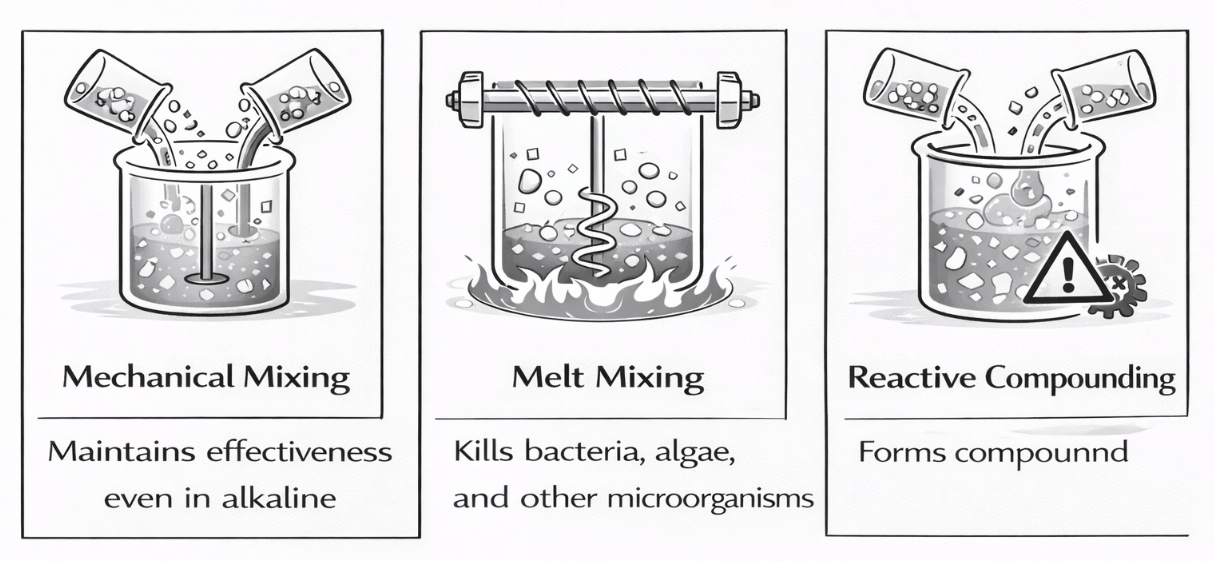
Several techniques are used to combine polymer materials, each influencing the final properties of the blend:
- Mechanical mixing, where polymers are physically combined in solution, commonly used in water treatment formulations
- Melt mixing process, where polymers are blended at elevated temperatures to achieve uniform dispersion
- Reactive compounding, where chemical reactions occur during blending to improve compatibility between otherwise immiscible materials
These methods determine how well the polymers mixed interact and whether the final system behaves as a stable and functional material.
Interfacial Effects and Compatibility
In systems where immiscible polymer combinations are present, the interface between phases becomes critical. The interfacial tension and interfacial tension coefficient influence how easily one polymer disperses into another. High interfacial tension can lead to poor dispersion, while lower values promote better interaction and stability.
Additionally, interfacial stress affects how the blend responds under mixing and application conditions. Managing these forces is essential for maintaining consistent performance, especially in systems with a minor component dispersed within a dominant phase.
Phase Morphology and Rheological Behavior
The internal structure, or phase morphology, of a polymer blend has a direct impact on its effectiveness in water treatment. Common structures include:
- Dispersed phase systems, where one polymer forms small domains within another
- Co continuous morphology, where both phases form interconnected networks
The distribution of phases is influenced by factors such as volume fraction and mixing conditions. These structural characteristics determine key rheological properties and overall rheological behavior, including viscosity, flow, and shear response.
In practical applications, these properties affect how polymers interact with suspended particles, form flocs, and perform under varying hydraulic conditions. By controlling the blending process and resulting morphology, water treatment professionals can tailor solutions to meet specific operational needs.
Types of Polymer Blends Used in Water Treatment
In water and wastewater treatment, polymer blends are designed by combining different component polymers to achieve targeted performance. These blends leverage the strengths of individual polymers while compensating for their limitations. By carefully selecting polymer components based on chemical structure and function, treatment programs can address a wide range of contaminants and operating conditions.
Charge-Based Polymer Blends
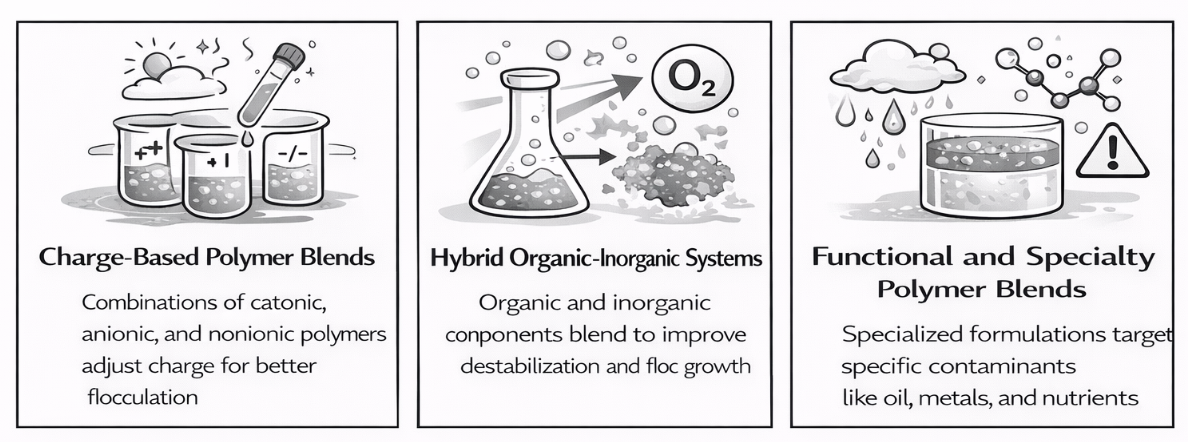
One of the most common approaches involves combining polymers with different charge characteristics, such as cationic, anionic, and nonionic materials.
- These blends rely on interactions between polymer molecules and suspended particles
- The combination of individual components improves charge neutralization and floc formation
- They are widely used in clarification and sludge dewatering processes
This type of system demonstrates how physical mixtures of co polymers can create a more effective treatment solution than any single material alone.
Hybrid Organic-Inorganic Systems
Another important category includes blends that combine organic polymers with inorganic coagulants. These systems function similarly to polymer alloys, where different materials are engineered to work together, much like metal alloys in structural applications.
- Organic polymers provide bridging and floc growth
- Inorganic components enhance initial destabilization
- The resulting blend improves overall separation efficiency
These systems are particularly effective in treating high-turbidity or high-solids water streams.
Functional and Specialty Polymer Blends
Advanced applications often require blends tailored for specific contaminants or performance goals. These include systems designed for oil separation, metals removal, and nutrient reduction.
- Some formulations use core shell copolymer structures to enhance performance
- Others incorporate biodegradable polymer blends for environmentally sensitive applications
- Adjustments in hydrophilic properties allow better interaction with waterborne contaminants
In these cases, the blend acts as a new material with specific properties that go beyond what standard formulations can achieve.
By combining several polymers into a unified system, water treatment professionals can create solutions that are both flexible and highly effective across a range of operating conditions.
Key Performance Advantages in Water Treatment
Polymer blends offer significant advantages over single-polymer systems by combining the strengths of different materials into a unified solution. When properly formulated, these blends create a new material with enhanced performance characteristics that directly improve treatment efficiency and operational reliability.
One of the primary benefits is improved mechanical properties, particularly in floc formation. Stronger and more cohesive flocs lead to better settling and dewatering performance, which supports overall mechanical integrity in separation processes. This results in more efficient clarification and reduced sludge handling challenges.
Another important advantage is enhanced chemical resistance. By combining polymers with different chemical structures, blends can withstand a wider range of contaminants and environmental conditions. This is especially valuable in industrial systems where influent composition can vary significantly.
Polymer blends also contribute to improved thermal stability and dimensional stability, helping maintain consistent performance across temperature fluctuations. In addition, they often exhibit more uniform behavior, achieving macroscopically uniform physical properties even when composed of materials with different physical properties at the microscopic level.
Factors Affecting Polymer Blend Performance
While polymer blends offer enhanced performance, their effectiveness depends on proper selection and application. Several key factors influence how these systems behave in water treatment environments, particularly when dealing with many polymers and varying operating conditions.
- Molecular Weight: The molecular weight of the polymers plays a critical role in floc formation and bridging capability. Higher molecular weight polymers typically improve floc size and strength, while lower molecular weight materials can enhance dispersion and reaction speed.
- Blend Composition and Ratio: The balance between individual components, including any minor component, affects overall performance. Even at low concentration, certain polymers can significantly influence system behavior, especially in partially optimized blends.
- Phase Behavior and Compatibility: The phase behavior of the system determines whether the blend remains stable or undergoes phase separation. Many water treatment formulations are partially miscible, meaning they rely on controlled interactions rather than full compatibility to achieve desired results.
- Material Selection and Properties: The choice of polymer materials directly impacts performance. Different materials contribute specific properties, such as charge density, hydrophilicity, and reactivity, which must align with the treatment objective.
- System Conditions: Variables such as pH, temperature, and contaminant load can influence how several polymers behave together. These conditions affect both the chemical interactions and the physical performance of the blend.
Understanding these factors is essential for optimizing treatment programs. Proper evaluation and adjustment ensure that polymer blends deliver consistent and effective results across a wide range of applications.
How ETI Supports Polymer Blend Applications
Effective use of polymer blends requires more than formulation. It depends on proper selection, testing, and real-world application. Eastern Technologies, Inc. (ETI) supports water treatment professionals with the technical depth, flexibility, and reliability needed to implement these solutions with confidence.
Custom Formulation and Blending
ETI offers a broad portfolio of polymer materials and works closely with partners to develop application-specific solutions.
- Custom formulations based on system requirements
- Flexible packaging, concentrations, and delivery options
- Guidance throughout the blending process to ensure optimal performance
This approach allows water treatment professionals to deliver precise, effective solutions across a wide range of applications.
Technical Support and Field Application
Polymer performance is highly dependent on correct application. ETI provides technical support to ensure consistent and reliable results.
- Jar testing and polymer screening
- Dosage optimization and feed strategy development
- Field troubleshooting and performance adjustments
With deep technical experience, ETI helps partners translate formulation into measurable system performance.
Partner With ETI
If you are evaluating or optimizing polymer programs, ETI provides the expertise and support to help you achieve consistent results.
Contact ETI today to discuss your application and develop a polymer solution tailored to your system.