Eastern Technologies, Inc. (ETI) has spent decades supporting water treatment professionals with reliable products and technical expertise. In complex water systems, maintaining consistent performance depends on more than correct dosing or product selection. One key factor that often determines success is chemical stability.
In water treatment, every chemical substance introduced into a system is subject to chemical reactions influenced by its environment. Changes in temperature, exposure to oxygen, or shifts in operating conditions can affect how a product performs over time. When stability is compromised, product quality can decline, leading to inconsistent results and operational challenges.
Understanding chemical stability is essential for maintaining reliable treatment programs. It directly affects how chemicals behave, how long they remain effective, and how well they support system performance. By recognizing the factors that influence stability, water treatment professionals can better control chemical and reduce the risk of unexpected changes in the field.
What Is Chemical Stability in Water Treatment?
Chemical stability refers to the ability of a chemical substance to maintain its chemical integrity, structure, and performance over time under defined conditions. In water treatment applications, this means that the product retains its intended function without undergoing unwanted chemical change that could reduce its effectiveness or alter its behavior in the system.
At a molecular level, stability is closely tied to chemical structure, including how atoms are arranged and how chemical bonds hold those structures together. These molecular structures determine how a chemical responds to environmental conditions and whether it remains stable during storage and application. The ability to determine stability is essential for ensuring consistent treatment outcomes and maintaining system reliability.
Types of Chemical Stability
In water treatment, stability can be viewed from two primary perspectives:
- Physical stability: Refers to maintaining physical properties such as appearance, solubility, and particle size without separation, precipitation, or phase changes.
- Chemical stability: Refers to the resistance of a chemical substance to decomposition, degradation, or reaction that alters its composition or performance.
Both forms are important, as changes in physical properties can often signal underlying chemical issues.
Thermodynamic vs Kinetic Stability
Chemical stability is also influenced by two important scientific concepts:
- Thermodynamic stability: Describes whether a compound is in its lowest energy, most stable state over time.
- Kinetic stability: Refers to how quickly a reaction occurs, even if the compound is not in its most stable form.
In practical terms, a product may be thermodynamically unstable but still usable if it remains unchanged long enough under normal conditions. This balance between stability and reaction rates plays a critical role in how water treatment chemicals are formulated and applied in real-world systems.
Key Factors That Influence Chemical Stability
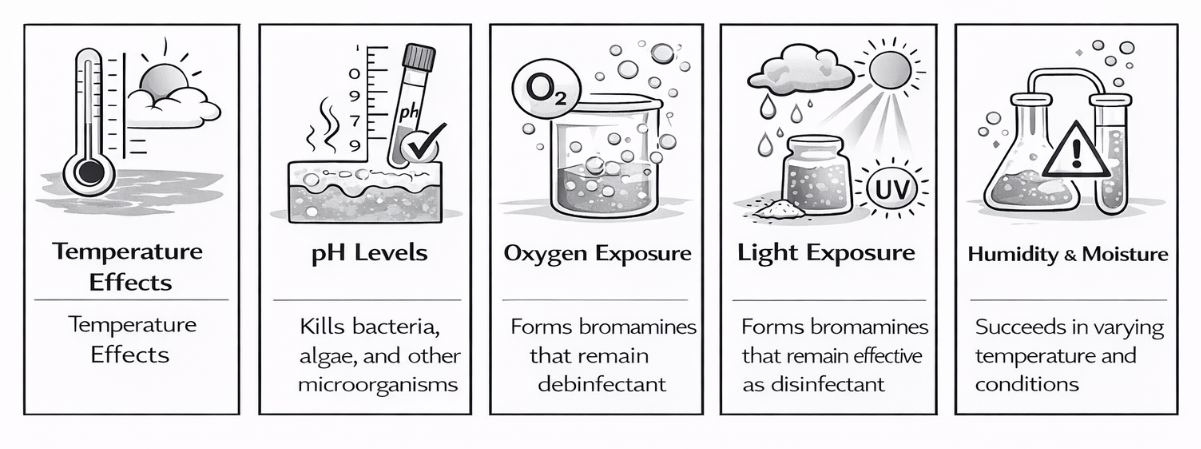
Chemical stability in water treatment systems is not fixed. It is influenced by various factors that can significantly impact how a product performs over time. Understanding these variables is essential for preventing unwanted reactions and maintaining consistent treatment results.
Temperature Effects
Temperature is one of the most influential factors affecting stability. Higher temperatures generally increase reaction rates, which can accelerate degradation processes such as chemical decomposition and oxidation.
- Heat can break down sensitive compounds more quickly
- Elevated temperature can shorten shelf life
- Some products remain stable at room temperature but degrade rapidly in warmer environments
Even small increases in temperature can have a direct effect on how long a product remains effective.
pH Levels
The pH of a system plays a critical role in determining how stable a chemical remains. Many water treatment products are designed to function within specific pH levels, and deviations can lead to instability.
- Extreme pH conditions can trigger hydrolytic degradation
- Certain compounds degrade faster in alkaline or acidic environments
- Shifts in pH can lead to unwanted chemical change
Matching chemistry to system conditions is essential to avoid performance loss.
Oxygen Exposure and Oxidation
Exposure to oxygen can lead to oxidation, one of the most common causes of chemical instability. This is especially important for products stored in partially filled containers or exposed to air over time.
- Oxygen exposure can cause oxidative degradation
- Active ingredients may lose strength due to oxidation
- Reactions with oxygen can form byproducts that affect product performance
Controlling oxygen exposure is critical for maintaining product stability during storage and use.
Light Exposure
Certain chemicals are sensitive to light exposure, particularly ultraviolet light. This can trigger unwanted reactions that alter the chemical composition.
- Light can initiate degradation reactions
- Some compounds break down faster when exposed to UV
- Improper storage in clear containers can reduce product stability
Protecting chemicals from light helps preserve their effectiveness.
Humidity and Moisture
Moisture in the environment, including high humidity levels, can affect stability, especially for dry or concentrated products.
- Water presence can initiate hydrolysis
- Moisture can change physical properties such as solubility or consistency
- Increased humidity can lead to premature reactions
Controlling environmental moisture is important for maintaining long term stability.
Chemical Interactions
The presence of other chemicals in a system can lead to unwanted reactions that compromise stability.
- Incompatible chemicals may react with each other
- Additives or contaminants can trigger degradation
- Interactions can result in loss of efficacy or formation of unwanted byproducts
Careful chemical formulation and application practices help prevent these interactions and maintain overall system performance.
Common Stability Challenges in Water Treatment Chemicals
Even when products are properly selected, maintaining chemical stability in real-world systems can be challenging. Many water treatment chemicals are exposed to dynamic conditions that can lead to chemical instability, resulting in reduced performance and shorter usable life.
One common issue is chemical decomposition, where compounds break down into simpler substances over time. This degradation can occur during storage or after the product is introduced into an aqueous solution, especially when environmental conditions are not controlled. As decomposition progresses, the effectiveness of the active ingredients declines, directly impacting treatment outcomes.
For example, certain biocides are designed to degrade quickly after application, but premature degradation during storage can reduce their intended efficacy. Similarly, oxidizing agents may lose strength due to uncontrolled reactions, while polymers used for dispersion or scale control can break down, altering their functional performance.
Common Chemical Stability Issues in Water Treatment
| Chemical Type | Stability Issue | Impact |
|---|---|---|
| Biocides | Rapid degradation | Reduced microbial control and lower efficacy |
| Oxidizers | Chemical decomposition | Loss of strength and inconsistent dosing |
| Polymers | Structural breakdown | Reduced dispersion and fouling control |
| Corrosion inhibitors | Chemical change | Increased risk of system corrosion |
These challenges directly affect product stability and can shorten the shelf life of treatment chemicals. In many cases, the goal is to achieve a balance between performance and durability, ensuring that products remain stable long enough to be effective while still performing their intended function once applied.
Understanding these issues allows water treatment professionals to make better decisions about product selection, handling, and application, ultimately supporting more reliable system performance and a longer shelf life for critical treatment solutions.
Storage and Handling Best Practices for Stability
Maintaining chemical stability does not end with product selection. Proper handling and storage conditions play a direct role in preserving performance, extending shelf life, and protecting overall product quality. Even well-formulated chemicals can degrade if exposed to unfavorable environments.
Storage Conditions
Proper storage is essential to minimize degradation and maintain long term stability.
- Store chemicals at recommended temperature, ideally near room temperature unless specified otherwise
- Avoid exposure to excessive heat, which can accelerate reaction rates and breakdown
- Protect products from direct light, especially UV exposure
- Minimize contact with air to reduce oxygen exposure and oxidation
- Control environmental factors such as humidity levels to prevent moisture-related degradation
Handling and Packaging
The way chemicals are handled and contained can significantly affect their physical properties and stability.
- Use appropriate packaging materials that are compatible with the chemical substance
- Ensure containers are tightly sealed to limit exposure to oxygen and contaminants
- Avoid transferring chemicals between incompatible containers
- Prevent contamination during handling, which can introduce unwanted reactions
Proper packaging helps preserve chemical integrity and reduces the risk of instability during use.
Inventory and Shelf Life Management
Effective inventory practices are critical for maintaining consistent product performance.
- Follow first-in, first-out (FIFO) inventory rotation to manage shelf life
- Monitor storage duration to avoid using degraded materials
- Be aware that some products are designed for shorter use windows, while others support a longer shelf life
- Regularly inspect stored chemicals for visible changes in form, color, or consistency
Maintaining proper storage and handling practices ensures that chemicals remain stable and effective, supporting reliable performance in water treatment applications.
How ETI Supports Chemical Stability in the Field
Maintaining chemical stability in real-world applications requires more than a well-designed product. It depends on the combination of formulation expertise, field knowledge, and consistent operational support. This is where Eastern Technologies, Inc. (ETI) plays a critical role as a partner to water treatment professionals.
ETI approaches formulation with a focus on performance and reliability. By carefully selecting compatible compounds and optimizing active ingredients, ETI helps ensure that products maintain their intended function across a range of operating conditions. Attention to formulation details supports product quality and reduces the risk of instability caused by environmental or system variables.
ETI also provides technical support to help partners evaluate stability in the field. This includes guidance on proper storage, application practices, and troubleshooting when performance issues arise. With access to testing tools and experienced technical staff, partners are better equipped to identify stability concerns early and take corrective action.
Key areas of support include:
- Technical expertise backed by decades of combined experience
- Custom formulation capabilities tailored to specific system conditions
- Laboratory assistance with testing and monitoring to validate performance
- Reliable manufacturing and delivery aligned with consistent quality standards
This support model reflects ETI’s role as a non-competing partner. The goal is not just to supply chemicals, but to help water treatment professionals maintain consistent results and protect product quality in the field.
To learn more about how ETI supports your programs, contact us today.